The Ultimate Balance Sheet Checklist for Your 2026 Business Loan Application

What if the difference between a "yes" and a "no" on your 2026 funding request has nothing to do with your revenue and everything to do with how you've organized your debt? Preparing a balance sheet for business loan application often feels like an intimidating hurdle, especially when you're worried that "messy" books or complex terms like liquidity might lead to a rejection. We believe your financial statements should act as a bridge to your future, not a barrier that keeps you from expanding.
You've likely felt the pressure of ensuring every decimal point is perfect before sitting down with a lender. It's natural to feel a sense of uncertainty about whether your equity is presented correctly or if your current ratios meet the bank's strict 2026 standards. This guide provides a clear, actionable checklist to help you structure and clean your financials to win over lenders and secure the capital you need. We'll examine exactly what banks look for today; giving you the strategic insight to walk into your interview with total confidence and a lender-approved report in hand.
Key Takeaways
Analyze your balance sheet to understand why lenders prioritize this "health certificate" over a profit and loss statement during risk assessments.
Master the essential components of a balance sheet for business loan application, focusing on meticulously reconciled cash balances and verified accounts receivable.
Locate and resolve critical red flags, such as negative asset balances, to prevent simple bookkeeping errors from stalling your funding.
Implement a step-by-step cleanup process that includes deep-dive bank reconciliations and strategic write-offs of uncollectible debt.
Transition from financial uncertainty to informed confidence by preparing a transparent narrative that proves your business is a safe investment.
Table of Contents
Why Your Balance Sheet is the 'Health Certificate' Lenders Require
The Loan-Ready Balance Sheet Checklist: Key Components to Include
Red Flags: Common Balance Sheet Errors That Stall Loan Approvals
Step-by-Step: Preparing Your Financial Records for a Bank Review
Strategic Financial Reporting with McConnell Bookkeeping in Mesa
Why Your Balance Sheet is the 'Health Certificate' Lenders Require
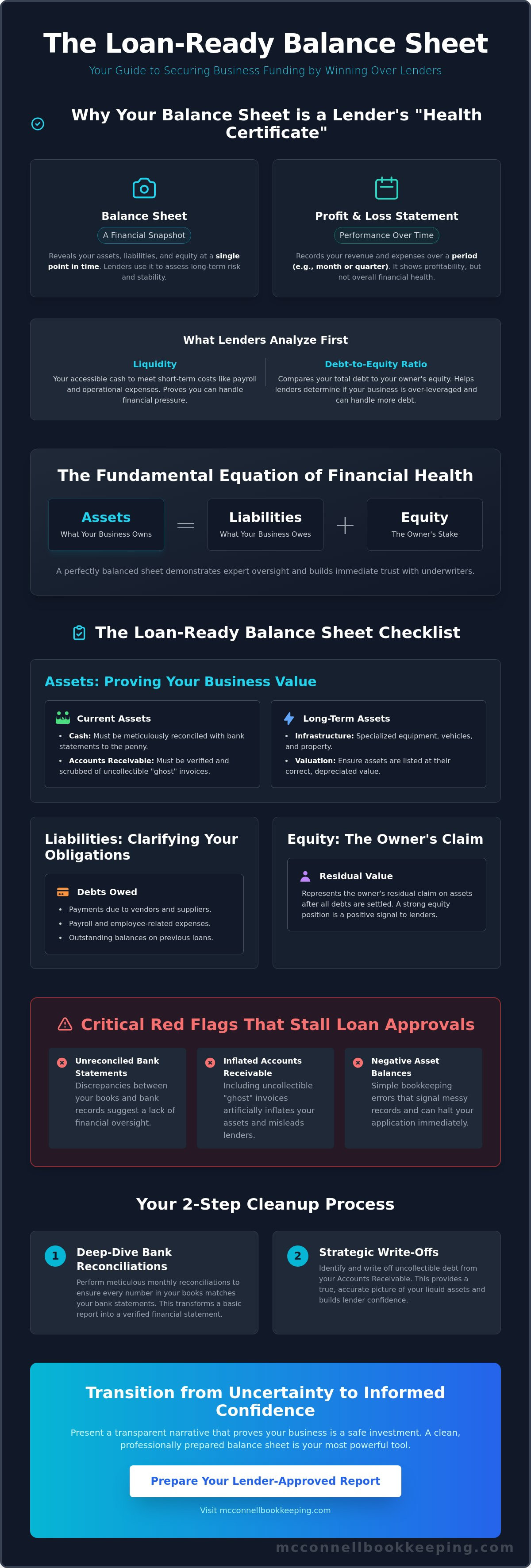
A Balance sheet acts as a definitive financial snapshot, providing a clear view of your assets, liabilities, and equity at a specific point in time. While a Profit and Loss statement records your performance over a period, the balance sheet measures your company's actual weight and worth. Lenders prioritize this document for long-term risk assessment because it reveals your business's ability to handle financial pressure and debt obligations.
Accurate reporting protects your reputation before you ever step into a bank. When you present a meticulously organized report, you demonstrate that your business is under expert oversight. This proactive approach transforms a standard administrative task into a strategic asset that builds immediate trust with bank underwriters. Professional oversight ensures you aren't just handing over numbers; you're handing over a narrative of reliability through an accurate balance sheet for business loan application.
To better understand how this document impacts your funding chances, watch this helpful video:
The Lender's Perspective: Assessing Risk and Reliability
Underwriters use your data to calculate the debt-to-equity ratio, which helps them determine if your business is over-leveraged. High revenue is impressive, but it means little to a lender if your debts outweigh your assets. Liquidity, or the amount of accessible cash on hand, is often the first metric a Phoenix bank manager evaluates. They need to know you can meet payroll and operational costs even if a client payment is late. We prioritize monthly bank reconciliations because they transform a basic report into a verified financial statement. This level of precision eliminates the "messy" data that often triggers a lender's rejection and ensures you're truly loan-ready.
Assets vs. Liabilities: The Foundation of Your Application
Your financial strength is built on the relationship between your resources and your obligations. Underwriters categorize these into specific groups to understand your stability:
Current Assets: These include cash and accounts receivable, representing your immediate spending power.
Long-term Assets: These cover infrastructure like specialized equipment, vehicles, or property.
Liabilities: These detail what you owe to vendors, employees, or previous lenders.
Equity is the owner's residual claim after all debts are settled. Professional bookkeeping oversight ensures these categories are distinct and accurate, providing the transparency required for a successful balance sheet for business loan application. When your books are clean, you present a position of strength rather than a list of questions.
The Loan-Ready Balance Sheet Checklist: Key Components to Include
Precision is the hallmark of a successful funding request. Every line item on your balance sheet for business loan application serves as a testament to your operational discipline. When a lender reviews your assets, they aren't just looking for high numbers; they're looking for verified facts that align with your tax returns and bank statements. Providing a clean, reconciled statement transforms your application from a simple request into a professional presentation of stability.
Asset Accuracy: Proving Your Business Value
Lenders view your assets as the primary collateral and the fuel for your business growth. To ensure these figures stand up to scrutiny, you must prioritize monthly bank reconciliations to the penny. Any discrepancy between your books and your bank statements can trigger an immediate red flag that suggests a lack of oversight. Beyond cash, your accounts receivable must be scrubbed of "ghost" invoices or uncollectible debts that artificially inflate your perceived value. Utilizing professional accounts receivable services ensures your aging report is accurate and reflects true liquidity. Additionally, verify that all fixed assets, such as vehicles or specialized machinery, are properly depreciated. Overstating the value of aging equipment is a common error that underwriters catch quickly during their review.
Liability and Equity: Showing Your Obligations
Transparency regarding what you owe is just as vital as proving what you own. Your balance sheet must clearly distinguish between short-term lines of credit and long-term notes to help lenders calculate your current ratio effectively. Verify that all accounts payable are current and that payroll liabilities are accurately recorded to show your business is a stable, compliant employer. For specialized sectors, such as legal firms, it's critical to ensure that specialized Law Practice Bookkeeping protocols are followed, specifically keeping IOLTA and Trust accounts entirely separate from firm assets. Lenders often require additional documentation to support these figures, such as the SBA Personal Financial Statement (Form 413), which verifies the relationship between your business equity and personal financial health. Properly reflecting owner contributions and draws for 2026 provides a clear narrative of how you reinvest in your own success, giving the bank the confidence they need to partner with you.
Red Flags: Common Balance Sheet Errors That Stall Loan Approvals
Lenders don't just look for profit; they look for proof. Presenting a balance sheet for business loan application that contains obvious errors is the fastest way to lose a bank's confidence. While many guides assume your financials are already pristine, the reality is that 'messy' books are often the primary reason for funding delays. Identifying these red flags early allows you to perform a necessary Books Cleanup, transforming your records into a reliable health certificate for your enterprise.
Unreconciled bank accounts represent the most common reason lenders lose trust in your data. If the cash balance on your report doesn't match your actual bank statement, the bank assumes the rest of your numbers are equally unreliable. Negative asset balances are another significant disaster. A bank account showing a negative balance on a financial report suggests either an overdraft or, more likely, a fundamental bookkeeping error that makes your business look financially unstable. We also frequently see old uncleared transactions, such as checks from 2024 that still haven't been dealt with, which distort your actual cash position. For Arizona small businesses, commingling personal and business expenses remains a major red flag; lenders want to see a clear separation to ensure the business is a viable, independent entity.
The Danger of 'Dirty' Data in QuickBooks
Uncategorized assets or liabilities make your business look unprofessional to a lender. These "placeholder" accounts suggest that you don't have a firm grasp on where your money is going. Missing loan documents or incorrectly recorded interest payments can also skew your debt-to-equity ratios. Investing in a professional QuickBooks training for business owners session can prevent these errors by teaching you how to maintain lender-grade records year-round. Clean data tells a story of competence and control.
Specific Pitfalls for Dental and Law Practices
Specialized industries face unique scrutiny during the loan process. Law firms often fail because they don't reconcile trust accounts against the balance sheet, creating a transparency gap that scares off underwriters. Dental practices sometimes struggle by mismanaging dental practice financial metrics, particularly when equipment loans are improperly recorded as simple expenses rather than long-term liabilities. Our targeted Books Cleanup service resolves these industry-specific red flags, ensuring your balance sheet for business loan application is accurate and compelling. We act as your diligent guardian, catching these discrepancies before a bank manager ever sees them.
Step-by-Step: Preparing Your Financial Records for a Bank Review
Preparation isn't just about gathering papers; it's about refining the data those papers represent. To secure funding in 2026, you must move beyond simply having numbers in a software program. A successful balance sheet for business loan application requires a methodical review of every account to ensure it reflects reality. This process involves a proactive deep-dive into your financial history to ensure that every asset and liability is verified and defensible. When you present a scrubbed, accurate report, you immediately position yourself as a low-risk borrower with a firm grasp on your operations.
The Cleanup Phase: Fixing Historical Errors
Looking back at least 12 to 24 months before applying for a loan is a strategic necessity. This historical review allows you to identify and resolve duplicate entries or missing bank feed transactions that often skew your financial totals. Utilizing peace of mind bookkeeping services provides the robust audit trail and financial clarity that bank underwriters demand. By cleaning up these historical errors, you build a foundation of transparency that reassures lenders of your operational discipline. Follow these tactical steps to ensure your data is lender-ready:
Perform deep-dive reconciliations for all bank and credit card accounts for both the current and prior years.
Scrutinize your Accounts Receivable aging report and write off debts that are no longer collectible to avoid overstating assets.
Cross-reference every loan balance on your balance sheet with actual bank statements to ensure liability accuracy.
Clearly categorize all owner draws and contributions so your equity position is unmistakable to the bank manager.
Final Review: The 'Lender’s Eyes' Test
Before submitting your application, evaluate your report through the eyes of a skeptical underwriter. Compare your current balance sheet to the previous year's figures to highlight growth trends and operational improvements. Ensure that outsourced payroll processing figures are correctly accrued as liabilities so your labor costs are transparent. You should also prepare a narrative for any unusual dips or spikes in your assets, such as a large equipment purchase or a seasonal inventory surge. Once you've generated a clean report, having a professional review it for anomalies can prevent a rejection before it happens. If you're ready to transform your financials into a powerful tool for growth, we invite you to contact our team for a professional books cleanup today.
Strategic Financial Reporting with McConnell Bookkeeping in Mesa
At McConnell Bookkeeping, we act as the diligent guardian of your financial integrity, ensuring that your records are always prepared for the scrutiny of a lender. We understand that a business owner's greatest asset is their time, yet administrative stress often blocks the path to expansion. By maintaining lender-grade accuracy through our specialized services, we transform your books from a source of anxiety into a strategic tool for growth. Our proactive approach means you never have to scramble at the last minute when preparing a balance sheet for business loan application; instead, you can proceed with the calm confidence of a leader who knows their numbers are 100% accurate.
Our monthly bank reconciliations provide the granular level of detail that modern underwriters require. We meticulously match every transaction to your bank statements, which eliminates the discrepancies that often lead to loan rejections. Serving the vibrant communities of Mesa, Phoenix, and Gilbert, we bring a neighborly expert perspective to every partnership. We don't just record data; we provide the strategic insight necessary to move your business from a state of uncertainty to a state of informed confidence.
Your Partner in Business Growth
A professional bookkeeper serves as a strategic mentor, helping you interpret the story your financials are telling. When you have clean, transparent financial statements ready at a moment's notice, you can seize opportunities as soon as they arise. While our team does not provide income tax return filing or certified audits, our meticulous financial statement preparation ensures that tax season and funding requests are seamless transitions rather than seasonal crises. We specialize in Books Cleanup for those whose records have fallen behind, restoring clarity and providing the audit trail needed for a successful balance sheet for business loan application. This expert oversight liberates you from the burden of back-office management, allowing you to focus entirely on your practice or firm's prosperity.
Ready to Apply? Let's Get Your Books Clean First
Transitioning from the stress of DIY bookkeeping to professional clarity provides an immediate sense of relief. You deserve to walk into your bank interview knowing that your debt-to-equity ratios are correct and your assets are fully verified. We invite you to experience the empowerment that comes from having a dedicated partner who is as invested in your success as you are. Whether you need a comprehensive Books Cleanup or ongoing monthly support, we are here to ensure your business remains loan-ready at all times. If you are ready to secure the funding your business needs to thrive in 2026, contact McConnell Bookkeeping today to schedule your consultation and take the first step toward strategic growth.
Secure Your Business Future with Financial Clarity
Mastering your financials is the most effective way to eliminate the stress of the funding process. By identifying red flags early, you transform your balance sheet for business loan application into a powerful narrative of stability. This meticulous preparation doesn't just satisfy a lender; it provides you with the strategic insight needed to lead your business with confidence. Precise records are the foundation of your expansion, ensuring you're ready for every opportunity that comes your way.
As QuickBooks Online ProAdvisor Certified experts serving Mesa, Phoenix, and the East Valley since 2020, we specialize in Law Practice Bookkeeping and Dental Practice Bookkeeping. We act as your diligent guardian, providing the expert oversight that makes your growth possible. Secure your funding with a professional Books Cleanup from McConnell Bookkeeping today. Our team is ready to deliver the transparency and reliability your business deserves. Walk into your next bank interview with total peace of mind and the funding you need to thrive.
Frequently Asked Questions
How do I make a balance sheet for a business loan?
You create a balance sheet by categorizing what you own, what you owe, and your total investment as of a specific date. Most successful owners use accounting software or partner with a professional for financial statement preparation to ensure every line item is verified. This structured approach guarantees your balance sheet for business loan application is accurate and organized for the bank's rigorous review process.
What do lenders look for on a balance sheet?
Lenders primarily evaluate your liquidity and the relationship between your total debts and your equity. They want to see that you have enough accessible cash to cover short-term obligations and that you aren't over-leveraged with existing loans. Underwriters also check for consistency between your statements and tax returns to verify your business's overall financial health and stability.
Can I use a QuickBooks balance sheet for a loan application?
You can use a QuickBooks balance sheet, but it must be meticulously reconciled and free of uncategorized entries to be lender-ready. Banks accept these digital reports when they are backed by an accurate audit trail and professional oversight. Many owners find that a Books Cleanup is necessary to fix historical errors before submitting these reports to a loan officer for approval.
Why is my balance sheet not balancing, and how do I fix it for a loan?
Your balance sheet fails to balance when assets don't equal liabilities plus equity, which is often caused by data entry errors or missing bank transactions. Fixing this requires a deep-dive bank reconciliation to identify discrepancies in your accounts and restore data integrity. Professional oversight ensures your balance sheet for business loan application remains perfectly balanced, which demonstrates your meticulous attention to detail to the bank.
How many years of balance sheets do banks usually require?
Banks generally require the last two to three full fiscal years of balance sheets along with a current year-to-date statement. This historical data allows lenders to track your growth trends and assess how you've managed debt over a significant period. Providing multiple years of clean data proves your long-term stability and builds a much stronger case for your funding request.
Does a balance sheet show my business profit?
A balance sheet shows your financial position at a single point in time rather than your total profit over a specific period. While your net income eventually flows into the retained earnings section of equity, the Profit and Loss statement is the primary document for showing earnings. The balance sheet's specific role is to prove you have the assets and equity to support your loan.
What is a good debt-to-equity ratio for a small business loan?
Lenders typically prefer a debt-to-equity ratio of 2:1 or lower, though requirements vary depending on your specific industry. This ratio measures how much of your business is financed by debt compared to what you have personally invested. Maintaining a lower ratio suggests you're a lower-risk borrower, making it easier for you to secure favorable interest rates and higher funding amounts.
Should I include personal assets on my business balance sheet?
You should never include personal assets on your business balance sheet because it commingles your finances and confuses bank underwriters. Lenders want to see a clear separation to evaluate the business as a standalone, viable entity. If a bank requires personal asset information, they'll ask you to complete a separate personal financial statement rather than including those items on your business reports.


Comments