Mastering Dental Practice Financial Metrics: A 2026 Profitability Guide

Did you know that 41.5% of dentists now cite rising overhead costs as their top business challenge? In the Phoenix metro area, where labor and operating expenses continue to climb, simply increasing your clinical output isn't enough to protect your margin. You need a precise understanding of your dental practice financial metrics to ensure that your hard work actually translates into realized profit.
It's exhausting to see high production numbers on your dashboard while your bank account tells a different story. You aren't alone if you feel that your QuickBooks reports are currently more confusing than helpful. This guide will show you how to gain clear visibility into your practice margins and reduce your days in accounts receivable. We will examine the essential KPIs for 2026 and explain how professional bookkeeping ensures your data is accurate enough to drive strategic growth.
Key Takeaways
Learn why clinical skill must be paired with financial precision to overcome the 2026 "fiscal squeeze" facing Arizona practices.
Identify the "Big Three" dental practice financial metrics to finally bridge the gap between your gross production and actual cash collections.
Discover how to liberate trapped capital by managing your accounts receivable aging and prioritizing the 0-30 day collection window.
Understand the role of monthly bank reconciliations in transforming messy QuickBooks data into a clear, accurate roadmap for your business.
Gain the confidence to make strategic investments by ensuring your financial statements are reconciled, transparent, and ready for action.
Table of Contents
Beyond Clinical Excellence: Why Dental Practice Financial Metrics Matter in 2026
Precision in the operatory is the hallmark of a great dentist, but precision in your ledger is what keeps the doors open. In 2026, the bridge between patient care and business sustainability is built on your dental practice financial metrics. For practice owners in Phoenix and Mesa, the days of managing by "gut feeling" have passed. As operating costs rise and the Arizona dental professional shortage persists, you need clear data to protect your margins and ensure your clinical hard work results in actual profit.
Recent data shows that 41.5% of dentists now cite overhead costs as one of their top three challenges. In Arizona, where only 34% of dental health needs are currently being met, the demand for care is high, yet the cost of delivery is surging. Labor expenses often consume 25% to 30% of revenue, leaving little room for error. Shifting your focus toward data-driven decision making allows you to identify exactly where your practice is thriving and where it is losing ground. This clarity transforms your role from a reactive provider into a strategic leader who controls the practice's destiny.
To better understand how financial arrangements impact your practice's bottom line, watch this helpful video:
The Shift from Clinical to Strategic Management
Being a brilliant clinician doesn't mean you automatically excel at the nuances of financial management. Strategic management requires you to look beyond daily production and analyze how rising supply costs and staffing pressures impact your bottom line. Real-time data empowers you to identify "leaks" in your revenue cycle, such as uncollected patient balances or ballooning laboratory fees, before they escalate into crises. With average dental practice overhead sitting between 60% and 67% in 2026, even a 2% shift in efficiency can represent tens of thousands of dollars in annual profit. By tracking these dental practice financial metrics, you gain the liberation that comes from knowing your business is on solid ground.
The Prerequisite: Accuracy Over Activity
A high-tech dashboard is a liability if the underlying data is flawed. This is the "Garbage In, Garbage Out" rule of dental accounting. If your bank accounts aren't reconciled, your financial reports are essentially fiction. You cannot make confident decisions about hiring a new hygienist or investing in a $150,000 technology upgrade based on unverified numbers. We provide a Professional Monthly Bank Rec Service to give you the clean, reliable foundation you need. Accurate bookkeeping ensures that every insurance deposit and supply purchase is accounted for, turning your raw activity into actionable insights. This meticulous oversight acts as a diligent guardian for your practice, ensuring your financial data is always ready for high-level analysis.
The Core Profitability Roundup: Production, Collections, and Overhead
Production, collections, and overhead form the vital trifecta of dental practice financial metrics. While clinical excellence brings patients through the door, these three numbers determine whether your practice thrives or merely survives. You must distinguish between what you bill and what you actually keep to maintain a healthy cash flow in the competitive Phoenix East Valley market. Understanding the relationship between these figures is the first step toward reclaiming control over your practice's financial destiny.
Production vs. Collections Ratio
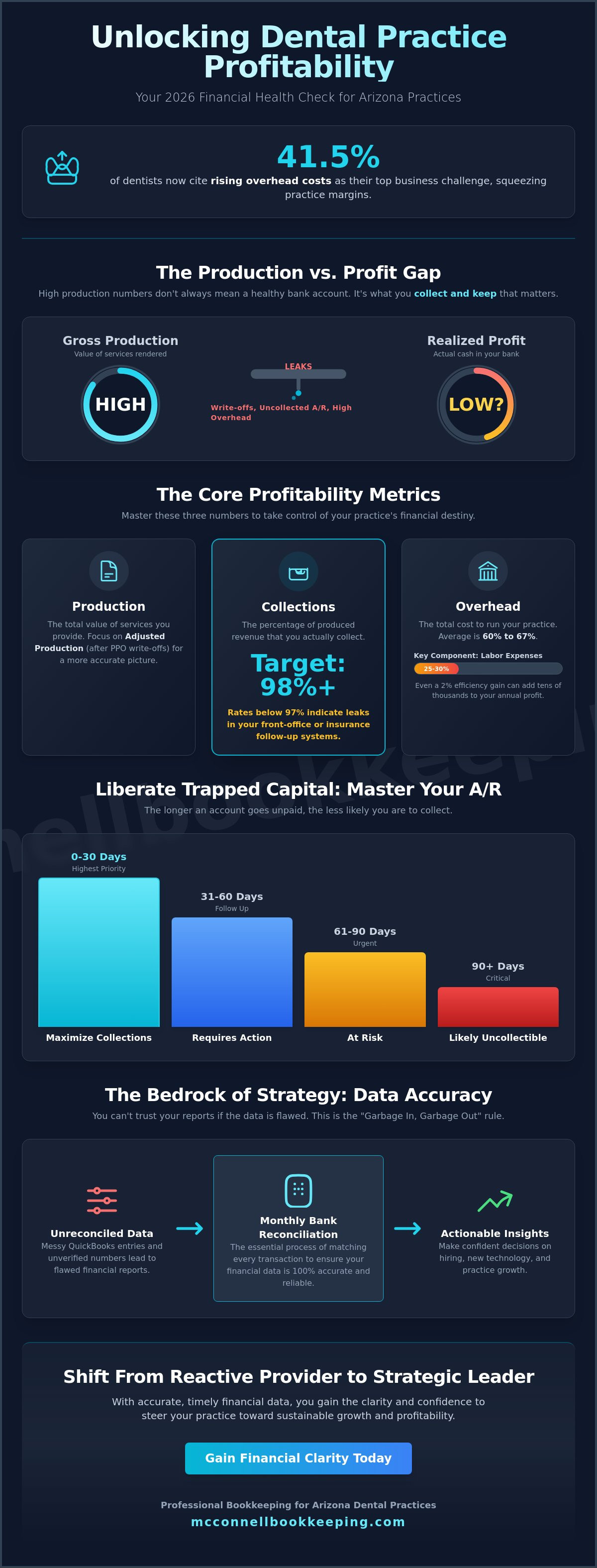
Gross production measures the total value of services rendered at your standard fees. However, adjusted production is the more critical figure, as it accounts for PPO write-offs and contractual adjustments. High-performing practices in Gilbert or Tempe target a collection rate of 98% or higher. If your rate falls below 97%, you likely have "leaks" in your front-office systems or insurance follow-up processes. Tracking this ratio monthly prevents your hard work from disappearing into uncollected balances and ensures your clinical efforts result in bankable revenue.
Mastering the Overhead Rate
The traditional 60% overhead rule is under significant pressure in 2026. Current data indicates that average overhead now ranges between 60% and 67%, with staff costs alone consuming 25% to 30% of revenue. Managing these costs requires a clear separation of fixed expenses, like rent in Mesa, from variable costs like dental supplies and lab fees. Top-performing practices achieve 50% to 55% overhead by optimizing their supply chains and maximizing production per employee. Our specialized Dental Practice Bookkeeping provides the granular categorization needed to spot these opportunities for cost reduction.
Calculating your true net profit margin requires looking at what remains after all operating expenses and provider draws are paid. It's common for owners to confuse their personal draw with actual practice profit. In 2026, top-tier practices are generating between $200,000 and $275,000 in production per full-time employee. If your numbers fall below this range while overhead climbs, your net profit margin will suffer. By monitoring these dental practice financial metrics with precision, you gain the clarity needed to adjust your fee schedules or renegotiate vendor contracts. This strategic oversight ensures your business remains a profitable asset rather than just a high-stress job.
Managing the Revenue Cycle: AR Aging and Patient Value
Generating production is only half the battle; the true challenge lies in converting that clinical effort into liquid cash. Your revenue cycle represents the heartbeat of your business, yet many owners allow their capital to stay trapped in insurance and patient balances for far too long. Mastering dental practice financial metrics requires a proactive approach to your accounts receivable and a deep understanding of the long-term value each patient brings to your chair. When you manage these cycles with precision, you create the financial breathing room necessary to scale your practice without the constant weight of administrative stress.
Accounts Receivable (AR) Aging Secrets
Healthy cash flow depends almost entirely on the 0-30 day AR bucket. Once a balance exceeds the 90-day mark, the likelihood of collection drops significantly, effectively turning that "revenue" into lost money. In Chandler and Scottsdale, where PPO participation remains high, insurance delays can quickly inflate your aging report if not monitored daily. Implementing Strategic Accounts Receivable Services in Mesa helps you identify these bottlenecks early, ensuring that insurance claims are followed up on before they become uncollectible. Maintaining a lean AR aging report provides the transparency you need to understand your practice's actual worth at any given moment.
Patient Retention and Acquisition Costs
The Phoenix market is exceptionally competitive, making patient acquisition a costly endeavor for solo practices. Research indicates that retaining an existing patient is five times cheaper than acquiring a new one, yet many clinics focus solely on the "new patient" count. You should track your hygiene re-appointment rate as a primary predictor of future revenue; a high rate suggests a stable, predictable income stream for the months ahead. Measuring Annual Patient Value (APV) further clarifies your clinical diagnostic effectiveness by showing the average revenue generated per active patient. When your APV and case acceptance rates align, it proves that your front desk and operatory are working in perfect harmony to maximize every opportunity.
Case acceptance serves as the vital link between clinical recommendations and financial results. If you present comprehensive treatment plans but your collections don't reflect that activity, there's a disconnect in how value is communicated or financed. By monitoring these specific dental practice financial metrics, you move beyond simple bookkeeping and into the role of a strategic mentor for your team. This oversight ensures that your hard-earned production doesn't just sit on a report, but actually arrives in your bank account to fuel your practice's growth and your personal prosperity.
From Raw Data to Actionable Insights: The Role of Monthly Reconciliations
Your clinical dashboard might show record-breaking production, but without a rigorous reconciliation process, those numbers are merely projections. Bank reconciliation serves as the "truth serum" for your dental practice financial metrics. It ensures that every insurance deposit, patient payment, and vendor expense recorded in your software actually matches the reality of your bank account. Without this verification, you risk overstating your profit by counting deposits twice or understating it by missing valid deductions. This precision is what separates a practice that is truly thriving from one that is simply busy.
Phantom income often haunts practices where personal and business expenses are blurred. When you use practice funds for non-business costs without proper classification, your financial statements become useless for strategic planning. Regular oversight provides the transparency needed to untangle these threads and provides the relief that comes from expert oversight. Additionally, providing your team with QuickBooks Online training ensures that the daily data entry is handled correctly from the start. This proactive approach prevents small errors from snowballing into a year-end accounting nightmare.
The Monthly Closing Process
Transforming your bank feed into a final financial statement requires a methodical closing process. For many Phoenix dental practices, this journey begins with a comprehensive books cleanup to resolve historical discrepancies and unreconciled insurance claims. Relying on Monthly Bookkeeping Services in Gilbert provides the structured oversight necessary to finalize your numbers each month. This process moves you from a state of uncertainty to a state of informed confidence. It allows you to see your actual margins with total clarity so you can make empowered decisions for the future.
Identifying Anomalies and Fraud
Meticulous reconciliations act as a powerful deterrent for internal theft and administrative errors. By reviewing every transaction, you can quickly spot duplicate vendor payments or unrecorded lab fees that drain your cash flow. This level of detail-oriented guardian work ensures your numbers are always tax-ready and loan-ready. Whether you're looking to expand your clinic or simply want peace of mind, having accurate data is the only way to move forward with certainty. If your books currently feel like a source of stress, our Dental Practice Bookkeeping experts can help you regain control and protect your prosperity.
Regularly reviewing your dental practice financial metrics through the lens of reconciled data gives you a strategic advantage. It prevents you from making expansion plans based on "phantom" profits that don't exist in your bank account. By treating your bookkeeping as a proactive partnership rather than a cold transaction, you ensure that your practice remains a stable and growing asset for years to come.
Strategic Financial Oversight for Arizona Dental Practices
Transforming your practice from a source of administrative stress into a predictable engine for wealth requires a shift in perspective. You've spent years mastering clinical techniques; now it's time to master the dental practice financial metrics that protect your hard-earned production. In the Phoenix and Mesa markets, where economic shifts happen rapidly, having a strategic mentor in your corner provides the clarity you need to thrive. We serve as the diligent guardian of your financial data, ensuring that every dollar is accounted for and every margin is transparent.
Professional oversight liberates you from the "fiscal squeeze" that many Arizona dentists face. By moving beyond simple data entry and into high-level analysis, you gain the confidence to make bold decisions about your practice's future. Whether you're considering a second location in Gilbert or upgrading your technology in Scottsdale, your decisions will be rooted in reconciled, verified reality. This methodical approach builds trust incrementally, moving you from a state of uncertainty to a state of informed confidence.
Why Partner with a Dental Bookkeeping Specialist?
Generic bookkeepers often fail to understand the unique nuances of the dental revenue cycle. They might miss the significance of PPO write-offs or fail to correctly categorize lab fees and dental supplies. We provide specialized Dental Practice Bookkeeping that speaks the specific language of your industry. Our team manages your monthly bank reconciliations and financial statement preparation with meticulous detail. We also work in tandem with your CPA to ensure your books are always tax-ready. This partnership makes tax season a non-event, as your records are already organized, reconciled, and accurate long before the deadline arrives.
Next Steps for Your Practice
The path to financial mastery begins with a clear understanding of where your records stand today. We recommend a structured approach to reclaiming your time and your profits:
Conduct a Books Cleanup: We perform a diagnostic review of your current QuickBooks file to resolve historical errors and unreconciled entries.
Establish a Reconciliation Rhythm: We set up a recurring monthly schedule for bank and credit card reconciliations to maintain data integrity.
Implement Strategic Reporting: We prepare financial statements that highlight your most critical dental practice financial metrics, allowing you to spot trends before they become problems.
You don't have to manage the complexities of your practice's finances alone. If you're ready to transition from DIY bookkeeping stress to professional clarity, we're here to help. Contact McConnell Bookkeeping today to discuss how our specialized services can support your growth in the East Valley. Let us handle the meticulous oversight of your books so you can focus on what you do best: providing exceptional care to your patients.
Securing Your Practice's Financial Future
Mastering your practice's growth requires moving beyond the chair and into the data. We've explored how understanding your overhead, managing your AR aging, and prioritizing monthly reconciliations transform your business from a source of stress into a streamlined asset. Accurate dental practice financial metrics provide the roadmap you need to navigate the rising costs of the Phoenix and Mesa markets with confidence. It's impossible to lead a multi-provider clinic effectively when you're guessing at your collections or struggling with messy QuickBooks files.
McConnell Bookkeeping offers the specialized expertise in Dental Practice Bookkeeping and Expert QuickBooks Online ProAdvisor training necessary to turn your raw numbers into strategic insights. As your local East Valley partner, we act as the diligent guardian of your records. We ensure every statement is reconciled and every margin is clear, providing the professional oversight that allows you to focus on patient care.
Ready for financial clarity? Schedule your dental bookkeeping consultation with McConnell Bookkeeping today.
You deserve the peace of mind that comes from knowing your practice is built on a foundation of professional precision. We're committed to helping you achieve the prosperity you've worked so hard to build. Let's ensure your business remains a thriving pillar of our community for years to come.
Frequently Asked Questions
What is a healthy overhead percentage for a dental practice in 2026?
A healthy overhead percentage for a dental practice in 2026 typically ranges between 60% and 67%, excluding the doctor's compensation. Top-performing clinics often achieve a leaner overhead of 50% to 55% through optimized supply chains and high production efficiency. Monitoring these figures allows you to identify where rising labor costs, which often reach 25% to 30% of revenue, might be eroding your profit margins.
How often should I review my dental financial metrics?
You should review your core financial metrics at least once a month after your bank accounts have been fully reconciled. Monthly reviews provide the visibility needed to spot trends in collections or overhead before they become systemic issues. For more dynamic clinics, tracking weekly production and collection targets ensures your team remains aligned with your annual profitability goals.
Why is my bank balance different from my profit and loss statement?
Your bank balance often differs from your profit and loss statement because the P&L tracks earned income and incurred expenses, while the bank balance reflects actual cash on hand. Non-expense items like loan principal payments or owner draws don't appear on a P&L but do reduce your cash. Regular monthly bank reconciliations are essential to bridge this gap and ensure your dental practice financial metrics accurately reflect your business's health.
What is the most important KPI for a new dental practice?
The most important KPI for a new dental practice is often the collection-to-production ratio, as it measures your ability to turn clinical work into usable cash. New practices must also closely monitor patient acquisition costs to ensure their marketing spend is generating a sustainable return. Establishing a strong collection rate of 98% or higher from the start builds the financial foundation necessary for long-term growth.
How can I improve my practice collection rate?
Improving your practice collection rate starts with a clear financial policy and consistent follow-up on insurance claims. You should aim to keep your accounts receivable in the 0-30 day bucket to maximize the likelihood of payment. Implementing a system for collecting patient co-pays at the time of service significantly reduces the administrative burden of chasing outstanding balances later.
Should I use QuickBooks Online for my dental practice bookkeeping?
QuickBooks Online is an excellent tool for dental practice bookkeeping because it allows for real-time collaboration with your financial team. It integrates with many dental practice management systems to streamline data entry and reporting. However, the software is only as good as the data entered; professional QuickBooks Online training ensures your team uses the platform correctly to maintain accurate records.
What are the risks of not reconciling my dental practice bank accounts monthly?
Failing to reconcile your bank accounts monthly creates a high risk of "phantom income" and undetected administrative errors. Without reconciliation, you might overstate your profit by missing duplicate expenses or fail to notice insurance deposits that were never actually received. This lack of oversight makes your dental practice financial metrics unreliable and can lead to significant stress during tax season or loan applications.
How do I calculate the annual value of a dental patient?
You calculate the annual value of a dental patient by dividing your total annual collections by the number of active patients seen within the last 12 months. This metric helps you understand the revenue potential of your existing patient base and guides your diagnostic strategies. Tracking this value alongside your hygiene re-appointment rate provides a clear picture of your practice's long-term sustainability and diagnostic effectiveness.


Comments