The Hidden Challenges of DIY Bookkeeping for Growing Arizona Businesses

What if the hours you spend "saving money" by managing your own ledger are actually the most expensive hours in your business week? Many Arizona entrepreneurs begin their journey by handling every bank reconciliation personally, believing that self-reliance is the fastest path to profitability. You likely value the control that comes with seeing every transaction, yet you probably also feel the pressure of spending your Saturdays on spreadsheets instead of with your family. The challenges of DIY bookkeeping often transform a well-intentioned cost-saving measure into a strategic bottleneck that prevents you from scaling your operations.
We understand that you want to grow your business without the constant fear of an IRS audit or uncertainty about your actual cash flow. This article reveals the strategic risks of managing your own books and shows you how to transition toward true financial clarity. Expert financial statement preparation provides the confidence you need to make bold growth decisions, while reclaiming your time for client acquisition ensures your business stays prepared for a successful 2026 tax season. You'll discover how to move from administrative stress to a state of informed confidence.
Key Takeaways
Evaluate the false economy of self-managed accounting to ensure your time is invested in high-value client acquisition rather than manual data entry.
Identify and navigate the common challenges of DIY bookkeeping, including the strategic risks of inaccurate bank reconciliations and the legal dangers of commingling funds.
Protect your business's creditworthiness by maintaining the precise financial visibility required to secure loans or monitor specialized industry metrics.
Recognize the immediate warning signs that your business growth has outpaced your current system, such as falling 30 days behind on your ledger.
Transition to professional oversight to gain a proactive partner who provides the transparency and reliability needed for a clean 2026 tax season.
Table of Contents
The False Economy: Why DIY Bookkeeping Costs More Than You Think
Many entrepreneurs in Mesa and Phoenix view self-managed accounting as a prudent way to protect their bottom line. They assume that by handling their own ledgers, they're preserving capital for other areas of the business. However, this perspective creates a false economy where the perceived savings are quickly eclipsed by invisible expenses. While following standard methods of bookkeeping might seem straightforward, the actual execution requires a level of precision that most busy owners cannot maintain without sacrificing growth.
The challenges of DIY bookkeeping often begin with the assumption that modern software does the work for you. Even with sophisticated tools like QuickBooks Online, which saw price increases in May 2026 for plans like Plus and Advanced, the technology is only as effective as its configuration. An incorrectly mapped chart of accounts or a misunderstood transaction category can lead to months of cleanup work later. This creates a significant mental load, as the constant uncertainty about your financial data makes it nearly impossible to make confident, data-driven decisions for your company's future.
To better understand this concept, watch this helpful video:
The "Admin Trap" for Service-Based Businesses
Dental and legal practices are particularly susceptible to administrative bloat because their financial requirements are inherently complex. Lawyers must manage IOLTA accounts with meticulous care, while dentists need to monitor specific profitability metrics to stay competitive. In the early "startup mode," doing everything yourself is a badge of honor. But as you transition into "growth mode," DIY efforts fail to provide the scalability you need. Professional oversight acts as a catalyst for expansion, transforming your back office from a source of stress into a streamlined engine for success.
Calculating Your Personal Hourly Rate
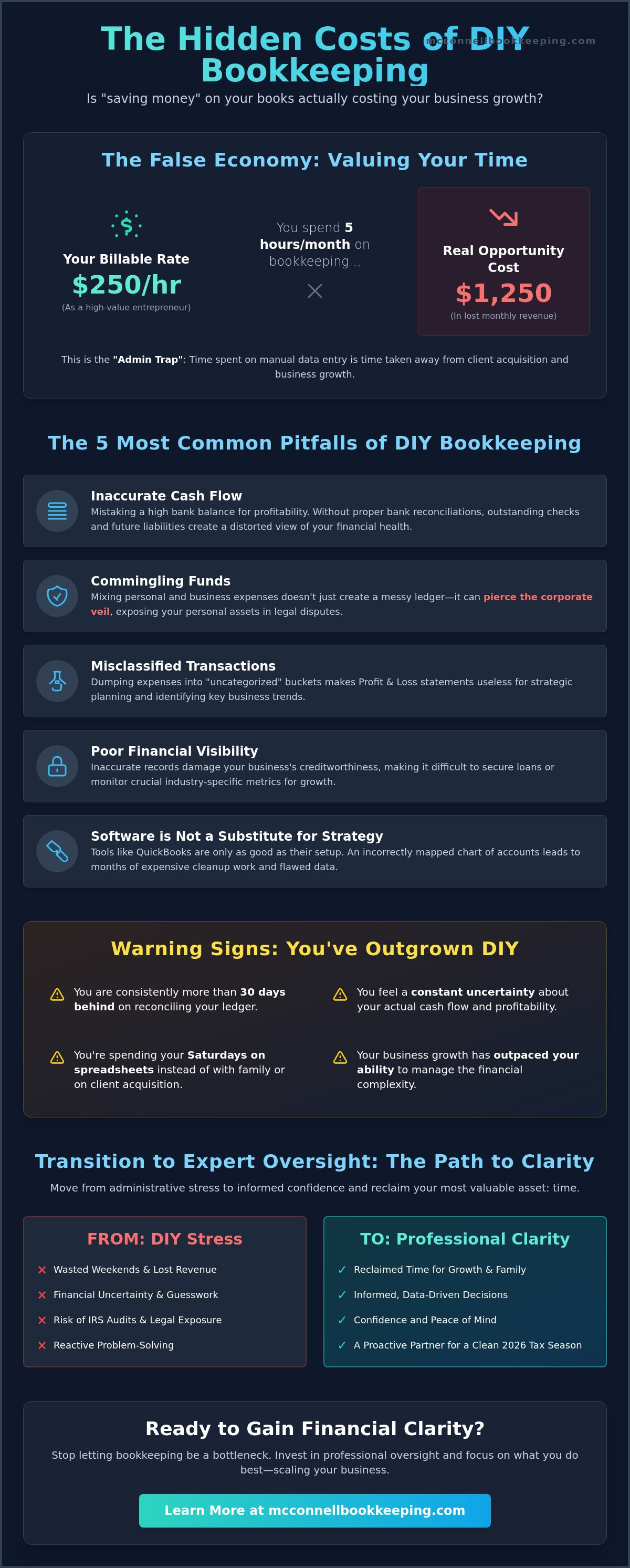
To see the true cost of DIY work, you must value your time accurately. If your billable rate is $250 per hour and you spend five hours each month struggling with software, that "free" DIY approach actually costs you $1,250 in lost revenue. Bookkeeping opportunity cost is the revenue lost when an owner stops selling or serving clients to reconcile accounts. Investing in a monthly bank rec service typically costs a fraction of your billable potential. By delegating these tasks, you reclaim your weekends and ensure your business remains focused on its primary mission: serving your clients and increasing your profit margins.
The 5 Most Common Pitfalls of DIY Financial Management
Managing a business in the Grand Canyon State requires more than just a passion for your craft. It demands a level of administrative precision that often eludes the busy entrepreneur. The challenges of DIY bookkeeping manifest most clearly when owners mistake a high bank balance for actual profitability. Without monthly bank reconciliations, your financial statements fail to reflect outstanding checks or future liabilities, leaving you with a distorted view of your cash flow. This lack of clarity often results in unexpected shortfalls just as you're ready to invest in growth.
Commingling funds remains a significant risk for Arizona business owners. Mixing personal grocery receipts with business expenses doesn't just create a messy ledger; it can pierce the corporate veil and expose your personal assets during legal disputes. Additionally, misclassified transactions often hide in "uncategorized" buckets. When expenses aren't assigned to the correct accounts, your profit and loss statements become useless for strategic planning. The U.S. Small Business Administration emphasizes the need for expert financial oversight to ensure long-term stability and compliance with federal guidelines.
Industry-specific requirements add another layer of complexity. Law firms must manage IOLTA accounts with zero margin for error to maintain their professional standing. Similarly, dental practices must navigate complex PPO management and insurance adjustments to track actual revenue versus billable amounts. Failing to address outsourced payroll processing standards can also lead to issues, especially with the Arizona minimum wage increase that took effect on January 1, 2026. If these pitfalls sound familiar, a professional books cleanup can restore your financial integrity.
The QuickBooks Online "Auto-Pilot" Myth
Many owners fall into the trap of trusting automated bank feeds without manual verification. Software often creates duplicate entries or matches transactions to the wrong vendors, which artificially inflates your perceived income or expenses. Relying on "auto-pilot" features without a foundational understanding of the software leads to significant data corruption. Investing in QuickBooks training for business owners helps you identify these automated errors before they skew your year-end reports.
Regulatory and Compliance Risks in Arizona
Arizona's Transaction Privilege Tax (TPT) system is notoriously complex because rates vary significantly by city and county. Poor record-keeping during a state audit can result in heavy penalties and interest on unpaid taxes. Historical errors often compound, making future tax preparation significantly more expensive. Correcting a year of sloppy records is always more costly than maintaining a clean set of books through proactive monthly oversight. Establishing a disciplined routine now prevents the administrative stress that typically arrives with the April 15 filing deadline.
The Strategic Price of Poor Financial Visibility
Financial visibility is the foundation of any successful expansion strategy. When your records are disorganized, you lose the ability to present a clear financial narrative to lenders or investors. One of the most significant challenges of DIY bookkeeping is the sudden realization that your messy ledger is the only thing standing between you and a critical business loan or line of credit. Banks require precise, up to date documentation to assess risk. If your statements are incomplete, you'll likely face rejection regardless of your actual revenue or the strength of your business model.
The U.S. Small Business Administration highlights that maintaining proper bookkeeping is a fundamental step in managing a healthy business. This level of detail is especially vital for specialized industries that rely on high precision. For instance, dentists must track specific dental practice financial metrics to understand their overhead, production, and collection ratios. Without this data, you're essentially flying blind. You won't be able to see which services are profitable and which are draining your resources until it's too late to pivot.
Accurate financial statements are required for strategic planning as we move through 2026. If you're relying on the "Tax Season Scramble" to sort through your receipts, you've already lost. Beyond the immediate errors, the long-term challenges of DIY bookkeeping involve losing your competitive edge. DIY books often lead to missed deductions because expenses aren't captured in real time, resulting in a higher tax bill than necessary. Proactive management ensures every legitimate business expense is recorded, protecting your hard earned profits from being lost to administrative oversight.
Losing the "Strategic Mentor" Perspective
Professional bookkeeping offers much more than simple data entry; it provides a proactive partnership. While DIY methods are reactive, professional oversight identifies cash flow trends before they escalate into crises. Having a diligent guardian for your business assets also serves as a critical defense against internal fraud. A strategic mentor looks at your balance sheet to spot opportunities for cost reduction that an exhausted business owner might overlook while reconciling accounts late at night. This oversight transforms your books from a chore into a roadmap for future success.
Cash Flow Bottlenecks in Phoenix Small Businesses
Stagnant growth in Phoenix often stems from unmanaged cash flow bottlenecks. There's a direct link between poor accounts receivable services and the inability to cover monthly operating costs. Owners often overlook aging invoices when they're buried under a mountain of manual data entry. Professional A/P and A/R management stabilizes your daily operations, ensuring that you collect what you're owed while maintaining strong relationships with your vendors. This stability allows you to focus on high level client acquisition instead of chasing payments.
Warning Signs: When to Stop Doing Your Own Bookkeeping
Recognizing the moment when your business has outgrown your personal capacity for administration is a vital sign of leadership. While you may have started your journey by managing every dollar yourself, the challenges of DIY bookkeeping eventually reach a tipping point where they hinder rather than help your expansion. If you find yourself more than 30 days behind on your bank reconciliations, you are essentially driving your company using a rearview mirror. Real time data is the only way to navigate the competitive Arizona market effectively and make informed decisions about your next hire or equipment purchase.
Another clear indicator is the presence of a large "Uncategorized" or "Suspense" account balance. These financial junk drawers often hide thousands of dollars in missed deductions or duplicated expenses. If you cannot produce an accurate Profit and Loss statement for a lender on demand, your business is not bankable. This visibility gap becomes particularly dangerous when your revenue is growing but your available cash is shrinking. This "growth paradox" often suggests that your margins are being squeezed or your collections are lagging, details that only professional oversight can clarify before they become a crisis.
The Emotional Burden of the "Financial Unknown"
Backlogged bookkeeping creates a specific type of "Sunday night dread" that drains your creative energy and focus. When you feel anxious about the state of your financial records, that stress inevitably trickles down to your team and affects your overall company culture. Leadership requires a clear head and a focus on the future, not a weekend spent wrestling with spreadsheets or bank statements. You can reclaim your mental space through peace of mind bookkeeping services, allowing you to lead with confidence rather than uncertainty.
Operational Red Flags in QBO
Operational failures often start with broken bank connections or stale reconciliations that have been ignored for months. A common but dangerous trap is the "forced reconciliation," where an owner manually adjusts a balance to match a bank statement without locating the missing transactions. This practice hides errors and makes future audits significantly more difficult and expensive. If your QuickBooks file has become a web of manual adjustments and duplicate entries, it's time to invest in a professional Books Cleanup service to reset your records and establish a clean foundation for growth.
If you recognize these warning signs in your own operations, it's time to transition from administrative struggle to strategic clarity. Contact us today for a professional Books Cleanup and experience the relief of having a diligent guardian for your financial health.
Reclaiming Your Time: Transitioning to Expert Oversight
Transitioning from a self-managed ledger to professional oversight is a significant milestone for any Valley entrepreneur. Many owners mistakenly believe that hiring help means simply finding a data entry clerk to type receipts into a software program. However, a strategic bookkeeping partner provides far more than clerical support; they act as a diligent guardian of your financial health. While a clerk records the past, a strategic partner interprets your data to identify growth opportunities and mitigate the challenges of DIY bookkeeping before they impact your bottom line.
The transition begins with a structured onboarding process designed to restore order to your administrative systems. When you engage with monthly bookkeeping services, you move through a methodical assessment of your current records. This phase identifies broken workflows and ensures your chart of accounts aligns with your specific industry needs. Whether you operate a law firm in Phoenix or a dental clinic in Mesa, this specialized support ensures that your financial statements reflect the unique complexities of your practice, such as IOLTA compliance or PPO adjustments.
Professional cleanup also serves as the ultimate preparation for a stress free tax season. While we do not file income tax returns, we provide the meticulous, reconciliation backed records that tax professionals require to maximize your deductions. By delivering a clean set of books for the 2026 tax season, you eliminate the frantic back and forth with your CPA and avoid the costly hourly fees they charge for basic cleanup work. You gain the freedom to focus on client acquisition while knowing your financial foundation is secure and transparent.
The Onboarding and Cleanup Process
McConnell Bookkeeping resolves historical accounting errors by performing a deep dive into your past transactions. We reconcile old bank statements, clear out "uncategorized" expenses, and correct duplicated entries that skew your profitability reports. This process transforms your DIY chaos into organized monthly reporting that you can actually use for decision making. We also establish clear communication channels for accounts payable and payroll management, ensuring that your vendors and employees are paid accurately and on time every month.
Empowerment Through Collaboration
Relinquishing the "heavy lifting" of data entry does not mean losing touch with your business finances. Instead, professional oversight empowers you through clarity and high level insights. We provide the training and reporting necessary for you to stay informed about your cash flow trends without sacrificing your weekends to spreadsheets. The long term ROI of this investment is found in the hours you reclaim and the strategic confidence you gain. To move your business toward financial liberation, schedule a consultation with McConnell Bookkeeping today and experience the relief of expert oversight.
Scaling Your Business with Financial Confidence
Your growth as an Arizona entrepreneur shouldn't be limited by the hours you spend wrestling with spreadsheets. We've explored how the challenges of DIY bookkeeping create a strategic bottleneck, from the hidden costs of lost billable time to the risks of compliance errors in legal and dental practices. By moving beyond reactive data entry, you transform your financial records into a roadmap for expansion. You deserve the peace of mind that comes with expert oversight, ensuring your business is bankable, compliant, and ready for the 2026 tax season.
McConnell Bookkeeping serves as a diligent guardian for firms across the Mesa and Phoenix area. As QuickBooks Online ProAdvisors, we specialize in the unique requirements of law and dental practices, providing the precision you need to thrive. It's time to reclaim your weekends and focus on what you do best: serving your clients and building your legacy. Get the financial clarity your business deserves—Contact McConnell Bookkeeping. Your path to financial liberation starts with a single step toward professional partnership.
Frequently Asked Questions
Is DIY bookkeeping worth it for a very small business?
Managing your own books may be cost effective during the initial startup phase when transaction volume is low. However, as your client base grows, the opportunity cost of your time often exceeds the perceived savings. Reclaiming these hours for billable work or strategic growth typically generates a much higher return than performing manual data entry yourself.
What are the most common mistakes in DIY bookkeeping?
The most frequent errors include failing to perform monthly bank reconciliations and commingling personal and business funds. These challenges of DIY bookkeeping often lead to large "uncategorized" expense balances that inflate your tax liability. Duplicate entries from automated bank feeds also commonly skew profit margins, which makes your financial statements unreliable for making major business decisions.
Can QuickBooks Online replace a professional bookkeeper?
No, QuickBooks Online is a powerful tool that still requires expert oversight to ensure data integrity. While the software automates certain aspects of data entry, it cannot interpret complex Arizona TPT regulations or manage specialized IOLTA accounts for law firms. A professional bookkeeper configures the system correctly, transforming raw data into the actionable insights you need to protect your business.
How much time should a business owner spend on bookkeeping?
Most small business owners find themselves spending five to ten hours per month on manual reconciliation and expense tracking. If you are spending more time than this, your administrative systems have likely become a bottleneck. Delegating these tasks to a specialist liberates your schedule, allowing you to focus on high level leadership and client acquisition instead of back office chores.
What happens if I make a mistake in my DIY books?
Errors in your records often lead to missed tax deductions, overpaid taxes, or increased scrutiny during an audit. Sloppy records also make it difficult to secure business loans because lenders cannot verify your actual profitability. Correcting historical errors through a professional cleanup is usually more expensive than maintaining accurate monthly records through consistent professional oversight.
How do I know if my DIY bookkeeping is actually accurate?
Your books are likely accurate if your bank balance matches your software balance to the penny every single month. You should also be able to produce a Profit and Loss statement that contains no balances in "Uncategorized" or "Suspense" accounts. If you feel a sense of uncertainty when opening your software, a professional review can provide the transparency and confidence you deserve.
What is the difference between a bookkeeper and a CPA?
A bookkeeper manages your daily financial transactions, reconciliations, and monthly reporting to keep your records organized and current. A CPA typically focuses on high level tax strategy and filing your annual income tax returns. Maintaining a clean set of books year round makes your CPA's job more efficient and often reduces your year end tax preparation costs.
When is the best time of year to switch from DIY to professional bookkeeping?
The best time to transition is immediately, regardless of the calendar date. Starting now allows for a thorough cleanup of historical data before the 2026 tax season arrives. Proactive oversight ensures your financial foundation is solid from day one, providing the clarity required to scale your business with confidence throughout the rest of the year.


Comments