Monthly Bookkeeping Checklist for Accurate Month-End Books

Accurate month-end books come from a repeatable routine, not a last-minute scramble. A monthly bookkeeping checklist sets out recurring checks for reconciling accounts, categorizing transactions, reviewing financial reports, and checking payroll activity. Completing these steps each month helps keep records organized and gives you a clearer view of your business finances.
Bookkeeping is more than entering transactions. Reliable records also depend on matching activity to statements, supporting documents, and payroll reports. A consistent process can reveal missing entries and unusual activity while the details are still fresh.
This guide explains what to include in your checklist and how to work through each task. Learn how to reconcile bank and credit card accounts, categorize income and expenses, review your profit and loss statement and balance sheet, and check payroll records. The result is a practical month-end routine that supports accurate reporting and more confident business decisions.
Table of Contents
Reconciling bank and credit card accounts
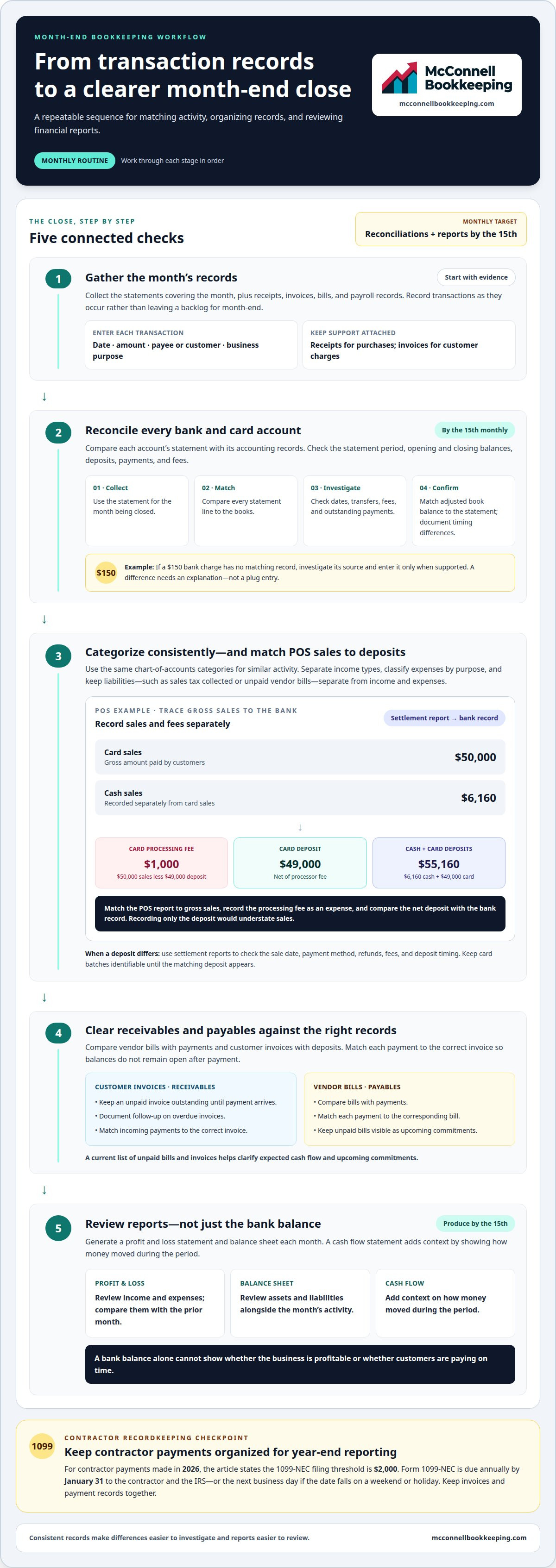
Reconcile each bank account and credit card account against its statement every month. Match the statement period, opening balance, closing balance, deposits, payments, and fees to the accounting records. This account-by-account comparison confirms that recorded activity agrees with the financial institution’s statement. The checklist recommends completing bank and credit card reconciliations by the 15th monthly, keeping month-end figures current for review.
Use a consistent sequence for each account:
Collect the statement. Use the statement covering the month being closed so transactions aren’t missed or carried into the wrong period.
Match every line. Compare each statement transaction with the accounting record to identify missing entries, duplicates, or unfamiliar charges.
Investigate differences. Check transaction dates, transfers, bank fees, and outstanding payments before making an adjustment.
Confirm the ending balance. Reconcile the adjusted book balance to the statement balance, documenting any timing differences that remain.
A difference deserves an explanation, not a plug entry. That makes sales and fees visible instead of understating income. If a $150 bank charge appears without a matching record, investigate its source and enter it only when supported. A clear reconciliation trail keeps statements and books organized for later review.
Include accounts payable and accounts receivable in the same close. Compare vendor bills with payments, and review customer invoices against deposits. Keep an unpaid invoice outstanding until payment arrives, and document follow-up on overdue invoices. A current list of unpaid bills and invoices helps clarify expected cash flow and upcoming commitments. Match payments to the correct invoices so customer balances don’t remain open after payment.
Contractor payment records also deserve attention during the close. According to the Internal Revenue Service, the 1099-NEC filing threshold for contractor payments made in 2026 is $2,000. Form 1099-NEC is due annually by January 31 to the contractor and the IRS, or the next business day if that date falls on a weekend or holiday, according to the Internal Revenue Service. Keeping contractor payments organized with invoices and payment records supports accurate year-end reporting.
Categorizing transactions and matching POS sales to deposits
Use the same chart-of-accounts categories for similar transactions each month. Assign income and expenses to the account that best reflects each transaction’s business purpose, then use that category for comparable entries. Consistent categorization keeps reports useful and makes unusual changes easier to spot.
Record transactions as they occur instead of leaving a backlog for month-end. Enter the date, amount, payee or customer, and business purpose in your accounting system. Attach the matching receipt or invoice. Each month, confirm all business activity is recorded and categorized, then upload receipts and match them to transactions.
Separate income types. Record sales, customer payments, and other income in the appropriate accounts, rather than combining unrelated sources.
Classify expenses by purpose. Put rent, supplies, payroll costs, bank fees, and vendor bills in their corresponding categories.
Record liabilities clearly. Keep amounts owed, such as sales tax collected or unpaid vendor bills, separate from income and expenses.
Match supporting documents. Attach receipts to purchases and invoices to customer charges, so each entry has a clear record.
Point-of-sale sales need a separate deposit match because processors deduct fees before sending funds. In one example, customers pay $50,000 by card and $6,160 in cash. The card company deposits $49,000 after deducting its fee, so combined cash and card deposits total $55,160. Match the POS report to gross sales, record the processing fee as an expense, and compare the net deposit with the bank record. Recording only the deposit would understate sales.
Use settlement reports to trace differences between sales and bank deposits. Check the sale date, payment method, refunds, fees, and deposit timing. A card batch, for example, may be recorded on one date and reach the bank later. Keep it identifiable until the matching deposit appears. This helps catch duplicate imports, missing deposits, and errors before they distort financial statements.
Apply categories consistently to customer invoices and vendor bills. A customer payment should reduce the correct receivable, and a vendor payment should clear the matching payable. Review uncategorized entries and identify what the transaction purchased or earned before assigning an account. Clear notes and attached documents make later reviews faster.
Accurate customer balances depend on recording invoices and matching incoming payments to them. For help keeping invoice records aligned with collections, accounts receivable management can support organized customer balances and clearer cash-flow tracking.
Reviewing profit and loss statements and balance sheets
Generate a profit and loss statement and balance sheet to review each month. The checklist recommends producing both by the 15th. A cash flow statement adds context by showing how money moved during the period. Together, these reports help explain income, expenses, assets, liabilities, and cash movement. A bank balance alone can’t show whether the business is profitable or customers are paying on time.
Review reports in sequence. First, compare current income and expenses with the prior month, looking for unusual spikes, duplicates, or missing entries. Next, check that the balance sheet reflects current assets, outstanding debt, and payroll liabilities. Then compare actual income and expenses with the budget. If a monthly expense rises unexpectedly, trace it to its account and supporting transaction before deciding whether it reflects a one-time purchase or an ongoing cost.
Review the profit and loss statement. Scan income and expense categories for unexpected changes that could distort the period’s reported profit.
Check the balance sheet. Confirm that account balances reflect recorded activity, including loans and amounts owed.
Compare actual results with the budget. Note the cause of each meaningful variance so decisions rely on context, not a single total.
Review cash flow. Compare cash movement with income and expenses to understand why available funds changed.
Use quarterly reviews to examine budget and forecast performance in more depth. Compare actual results with the forecast, then update assumptions if business activity has shifted. Review loans, payroll liabilities, and deferred revenue or expenses during this check. These balances can affect how reports show obligations and income across periods. Support adjustments with records and keep them consistent with your accounting method.
Review payroll separately because employee costs affect multiple reports. Compare payroll records with payroll reports, then confirm employee payments, taxes, and benefits appear in the correct accounts. Document and categorize reimbursements separately so they don’t disappear into a general expense total. Accurate payroll classifications matter when assessing reported results.
Close with a brief review note for each exception. Record the affected account, the reason for the variance, and any follow-up needed. For example, flag an unexplained change in a loan balance or a payroll amount that doesn’t match its report. Clear notes support accurate financial statements and preparation for filing. Review bank and credit card balances alongside the reports, but don’t treat available cash as a substitute for profitability or a measure of outstanding obligations.
What is a bookkeeping checklist?
A bookkeeping checklist is a repeatable set of tasks for gathering, recording, and reviewing business records. Assign an owner to each step and organize supporting documents so month-end reports have a clear audit trail. Make the checklist detailed enough to track, but simple enough to use consistently.
Record-retention periods vary by record type and business. Keep bookkeeping records and supporting documents for the period required by applicable rules, and store them in an organized, accessible system for future reference.
Begin each monthly close by collecting documents that explain business activity. Gather bank and credit card statements, receipts, customer invoices, vendor bills, payroll records, and bookkeeping reports. If the business accepts card payments, include sales records and payment processor summaries. Missing paperwork can make even an accurate entry difficult to support.
Collect statements and reports. Save records for each business account and the period being closed.
Gather receipts and invoices. Match purchase receipts to expenses and customer invoices to payments.
Include payroll documents. Keep payroll reports with records of employee pay and related transactions.
Identify missing documents. Maintain a short follow-up list with the transaction, document needed, and responsible person.
Record cash activity promptly, including cash sales, deposits, and business purchases paid in cash. Attach the receipt or a clear note describing the transaction’s purpose. If a receipt is missing, flag the entry, record the available details, and follow up for supporting documentation. This makes gaps visible before reports are finalized.
A weekly review helps catch open items before the monthly close. Check cash activity, customer balances, and vendor bills, then update the follow-up list. For example, mark an invoice as paid only after applying the payment to the correct customer balance. Review upcoming payables alongside expected receipts to understand near-term cash flow.
Store documents in a consistent folder structure, such as by year, month, and record type. Use clear file names that identify the date, vendor or customer, and document purpose. Keep digital backups of receipts, invoices, and statements so a misplaced file doesn’t break the record trail. Limit access to people responsible for bookkeeping and financial review.
At month-end, compare collected documents with recorded activity and the reports they support. Resolve missing receipts, statements, or invoices before considering the records complete. A well-maintained checklist also clarifies handoffs: one person gathers documents, another records or reviews them, and the owner addresses unresolved items.
Checking payroll activity against payroll reports
Payroll reports connect employee pay activity to expenses and liabilities in your books. During each monthly close, compare payroll summaries with recorded wages, employer taxes, benefits, deductions, and reimbursements. This helps ensure the profit and loss statement reflects payroll expenses and the balance sheet shows related amounts owed. Use the payroll register, payment records, and accounting entries for the same period.
Follow a consistent review sequence:
Match gross wages. Compare employee earnings in the payroll register with wage expenses recorded in the accounting system.
Compare net pay. Match payroll payments with bank activity, and investigate amounts that don’t agree.
Review taxes and benefits. Compare payroll report totals with the corresponding liability accounts and recorded payments.
Check reimbursements. Confirm employee expenses have supporting documentation and aren’t included in wages by mistake.
Trace differences. Note the employee, pay period, account, and reason before correcting an entry.
Payroll software can produce summaries, but imported totals still need review. A report may separate wages, deductions, and employer costs, while the bookkeeping system groups entries differently. Compare each component with its intended account instead of matching only the payroll total. If the report includes a reimbursement, make sure the related expense is recorded in the appropriate category.
When recording payroll, distinguish the payment date from the period when employees earned the wages. Use the payroll report and accounting method to determine which period each entry belongs to. If earned wages remain unpaid at period-end, record an adjusting entry when appropriate, then clear the liability when payment is recorded. Keep the report and adjustment together so the balance sheet entry has a traceable explanation.
Review unusual changes before closing the period. Compare current payroll totals with employee hours, wage rates, benefit deductions, and approved reimbursements. A change might reflect a new hire, a schedule change, or a corrected payroll entry. Verify the reason against the supporting payroll record, then document any correction rather than changing a total without context.
Keep payroll reports, payment confirmations, and adjustment notes organized by pay period. This creates a clear path from source report to accounting entry and helps explain differences during later financial review. If payroll entries need ongoing coordination with bookkeeping, use payroll management support to keep payroll activity and recorded accounts aligned.
McConnell Bookkeeping: Monthly Bank Reconciliations
McConnell Bookkeeping provides Monthly Bank Reconciliations to match recorded activity with account statements and keep your books organized. This service can help when month-end matching is difficult to manage, differences remain unexplained, or bookkeeping has fallen behind.
Once account activity is reconciled, Financial Statement Preparation turns organized records into reports for reviewing business performance. Book Clean-up helps bring disorganized or outdated records back into order, while Accounts Receivable Management supports tracking customer invoices and payments. Choose the service that fits the bookkeeping task you need handled.
For help keeping your month-end records accurate and easier to review, contact McConnell Bookkeeping.
Make Your Month-End Routine Sustainable
A dependable close is more than a list of tasks. It provides a repeatable way to move from daily activity to decisions grounded in current records. Assign ownership for gathering documents, recording transactions, resolving questions, and reviewing results. Keep the process consistent, and adjust it when your business changes or a handoff creates delays.
Your monthly bookkeeping checklist becomes a practical management tool when each step leads to a clear next action. Use the completed close to identify what needs attention, what information is still missing, and which process could be simpler next month. A steady routine helps you spend less energy chasing details and more time planning with confidence.
If you’d like support establishing a reliable month-end process, contact McConnell Bookkeeping. A clear next step can make your books easier to manage and your decisions easier to approach.
Frequently Asked Questions
Why Is Monthly Bookkeeping Important for Small Businesses?
Monthly bookkeeping gives owners timely information for decisions instead of an outdated picture. Comparing revenue trends with upcoming bills, for example, can help identify a cash shortfall early enough to plan. Current records also make it easier to investigate unusual activity while the people involved still remember the transaction. A consistent close supports clearer planning and helps prevent unresolved items from accumulating.
What tasks should a monthly bookkeeping checklist include?
A practical checklist covers transaction entry, account reconciliations, document collection, open invoices and bills, payroll review, and financial report review. Assign an owner to each task and record its completion status. One person, for example, can gather source documents while another reviews unresolved entries. Tailor the checklist to your payment methods, accounts, payroll activity, and reporting needs, then update it when those processes change.
What documents and financial records should be gathered each month?
Gather records that explain business activity and support accounting entries, including account statements, sales summaries, receipts, invoices, bills, payroll records, and loan activity. Group digital copies by period and document type. A file name such as “Vendor name, purchase receipt, month” makes retrieval easier. Retain records according to applicable requirements and keep backups so a lost device or misplaced paper doesn’t erase the record trail.
How do you reconcile bank and credit card accounts monthly?
Start with the statement’s opening and closing balances, then trace transactions to the ledger and investigate anything that doesn’t align. Look for timing differences, such as a deposit recorded before it appears on the statement or a payment that hasn’t cleared. Distinguish these items from errors, and document the reason for any adjustment. Review each account separately so activity from one card or bank account isn’t overlooked.
How do you review accounts receivable and follow up on overdue invoices?
Review an accounts receivable aging report to see which invoices remain unpaid and how long each has been open. Confirm that payments and credits are applied to the correct customer before following up. A useful message identifies the invoice, amount due, and a clear next step for resolving payment. Record the date and outcome of each contact, and flag disputed invoices so they receive attention apart from routine reminders.
How do you review accounts payable and schedule upcoming payments?
Compare the accounts payable list with vendor invoices, noting due dates, approval status, and disputed charges. Schedule payments in line with expected cash inflows, while avoiding duplicate entries for the same bill. Mark an invoice as scheduled only after confirming its vendor, amount, and payment status. A forward-looking payable list helps owners plan cash use and track commitments clearly.
How should payroll, sales tax, and other tax liabilities be recorded each month?
Record each liability in its own account, separate from the expense that created it. Use payroll reports to post wages, deductions, employer costs, and amounts owed, then reduce the relevant liability when recording a payment. Apply the same principle to sales tax collected: track the amount owed separately from sales income. Reconcile liability balances to supporting reports and payment records, and maintain a calendar for applicable filing and payment dates.
How do you review the profit and loss statement and balance sheet for errors?
Check that report periods and accounting settings match the month under review, then trace unexpected balances to their underlying entries. Look for duplicate postings, misclassified transactions, and balances that don’t fit the account’s purpose. Compare the current report with supporting schedules, such as loan or payroll records, and document corrections before finalizing reports. A review note naming the account and reason for an adjustment makes later questions easier to resolve.



Comments