How to Pay Myself From My LLC: Choose a Draw or Payment

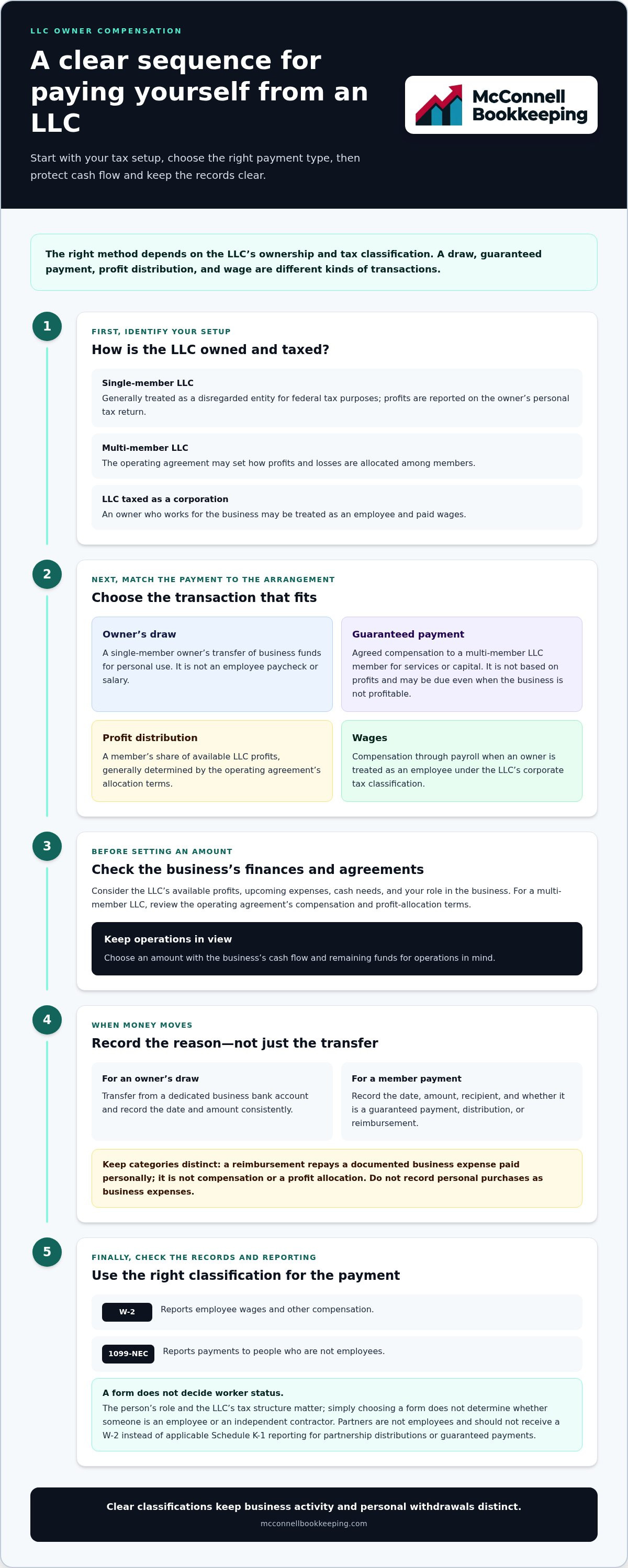
The right way to pay yourself from your LLC depends on how the business is taxed: a single-member LLC owner generally takes draws, while a multi-member LLC may use guaranteed payments for fixed compensation. If the LLC is taxed as a corporation, owner-employees are paid wages. The IRS uses Form W-2 for employee wages and Form 1099-NEC for payments to nonemployees, but issuing a form doesn’t determine someone’s worker status.
It’s reasonable to want to know how much you can take without disrupting your LLC’s cash flow or records. The right approach depends on the LLC’s tax treatment, available profits, cash needs, and your role in the business.
This guide explains how owner’s draws and guaranteed payments work, what to consider when choosing an amount, and when W-2 or 1099-NEC reporting applies. You’ll also see why a single-member LLC’s draw is different from a salary, and how organized bookkeeping can help you track money moving between the business and you.
Table of Contents
What Is an Owner’s Draw?
An owner’s draw is money an LLC owner takes from the business for personal use. For example, a single-member LLC owner can transfer funds from the business bank account to a personal account and record the transfer as a draw. This moves cash to the owner, but it is not the same as paying an employee through payroll. The appropriate payment method depends on the LLC’s ownership and tax structure.
A single-member LLC has one owner and is generally treated as a disregarded entity for federal tax purposes. The Internal Revenue Service says its profits are reported on the owner’s personal tax return. In this setup, an owner’s draw is a way to take money out of the business, not a W-2 paycheck. The owner should record each transfer clearly so the books show business activity separately from personal spending.
A multi-member LLC has two or more owners. Its operating agreement may specify how profits and losses are divided among members, based on ownership shares or other agreed terms. A member’s withdrawal should not automatically be recorded as wages or treated as the member’s full share of profits. For example, the books may need to distinguish a cash transfer from the LLC’s allocation of profits.
An LLC’s tax classification can also change how an owner is compensated. When an LLC is taxed as a corporation, an owner who works for the business may be treated as an employee and paid wages. The Internal Revenue Service generally treats a corporate officer who performs services for a corporation as an employee for U.S. tax purposes. That makes the draw-versus-payroll distinction important: a transfer labeled “draw” doesn’t by itself establish the correct tax treatment.
Reporting forms describe different types of payments. According to the Internal Revenue Service, Form 1099-NEC reports payments to people who are not employees, while Form W-2 reports employee wages and other compensation. A business can’t determine whether someone is an employee or independent contractor just by choosing a form. The owner’s role and the LLC’s tax structure matter more than the label entered in bookkeeping software.
Keep business and personal finances separate by using a dedicated business bank account. When taking a draw, transfer funds from that account, record the date and amount, and label the transaction consistently in your books. Do not record personal purchases as business expenses. Clear records show what the business paid, what you withdrew, and how much cash remains for operations.
State and local rules can affect how an LLC handles its obligations and reports business activity. Identify the jurisdictions relevant to your business, and account for applicable requirements when recording owner payments. Federal tax classification does not replace the need to account for state or local obligations.
To decide how to pay yourself from your LLC, first identify its ownership structure and tax classification. Then use a consistent accounting entry for each draw, wage, or member payment. Accurate classification keeps bank activity and financial records aligned, helping you distinguish business funds from money taken for personal use.
What Are Guaranteed Payments?
Guaranteed payments compensate a member of a multi-member LLC for services or capital. The members agree on the amount, which is not based on the LLC’s profits and may be due even when the business is not profitable. For example, an LLC agreement may provide a fixed payment to a member for managing operations, separate from that member’s share of remaining profits.
A profit distribution is different. It gives a member part of the LLC’s available profits, generally according to the allocation terms in the operating agreement. A guaranteed payment is compensation under the agreed arrangement, not simply a withdrawal of profit. Recording the transactions separately helps members see what the LLC paid for services and what it allocated as profit.
For federal tax purposes, guaranteed payments to members are generally treated as personal income to the recipient and as a business expense for the LLC. The expense can affect the business’s reported profit, while the recipient records the payment as income. Accurate entries matter: recording a guaranteed payment as a distribution can misstate both the LLC’s expenses and its remaining profit.
The Internal Revenue Service says partners are not employees and should not receive Form W-2, Wage and Tax Statement, instead of Schedule K-1 of Form 1065 for partnership distributions or guaranteed payments. The partnership reports the member’s share through the applicable partnership tax reporting, rather than treating the member like a payroll employee. An LLC taxed as a corporation follows a different compensation framework, so its tax classification matters.
An owner draw, distribution, and reimbursement describe different money movements. A draw is an owner’s withdrawal; a distribution is a member’s share of LLC profits or assets; and a reimbursement repays a member for a documented business expense they paid personally. For example, a member’s personal purchase of an LLC supply should be recorded separately from compensation or profit allocation.
Start with the reason for each payment. Record the date, amount, recipient, and whether the transaction is a guaranteed payment, distribution, or expense reimbursement. Compare the entries with the operating agreement and financial statements. This helps members review compensation, understand profit allocation, and address discrepancies before they complicate reporting.
For members weighing a fixed payment against profit distributions, financial statements help show the LLC’s income, expenses, and available cash. Financial statement preparation can organize those figures so members have a clearer basis for reviewing compensation and business performance.
Determining how much to pay yourself
The right amount depends first on how your LLC is taxed. A single-member LLC treated as a disregarded entity handles owner compensation differently from an LLC taxed as a corporation. Before choosing a payment method, identify the tax classification and whether the money is a draw, guaranteed payment, or wage. The classification matters because each describes a different transaction.
For an LLC taxed as an S corporation or C corporation, an owner who works in the business should receive a reasonable salary. The salary should reflect the work performed, not simply the amount the owner wants to withdraw. A corporate officer’s wages should generally be commensurate with their duties. Consider responsibilities such as managing employees, serving customers, or overseeing daily operations.
Next, review the business’s actual profits and cash flow. A profit shown in a report does not necessarily mean the same amount is available in the bank. Cash may already be needed for operating expenses, supplier bills, payroll, or upcoming obligations. Compare cash on hand with expected receipts and payments before setting an owner payment. This helps prevent a planned withdrawal from disrupting ordinary business activity.
A useful review considers these factors together:
Tax classification: Identify whether the LLC is treated as a disregarded entity, partnership, S corporation, or C corporation.
Work performed: For an owner-employee, connect salary to actual duties and responsibilities.
Operating cash: Account for near-term expenses and the timing of customer payments.
Profitability: Review financial statements to understand income, expenses, and business results.
Member arrangements: For a multi-member LLC, compare proposed payments with the operating agreement.
For example, a service business might report a profitable period while waiting for customers to pay invoices. Before deciding whether cash supports a withdrawal, its owner can review accounts receivable alongside upcoming expenses. If collections arrive later than expected, the owner can reconsider the amount instead of relying on profit alone. A business with steadier cash receipts may reach a different decision after the same review.
Revisit your decision as business conditions change. New expenses, slower collections, added responsibilities, or a change in tax classification can affect both the appropriate amount and how the payment should be recorded. Document the basis for your decision, then compare it with the LLC’s books and financial statements. Consistent records distinguish owner compensation from operating expenses and show how much cash remains for the business.
Owner’s draws for single-member LLCs
A single-member LLC has one owner, so a draw moves business funds to that owner. The Internal Revenue Service generally treats a single-member LLC as a disregarded entity for tax purposes. Its profits are reported on the owner’s personal tax return. A draw records a cash transfer; it doesn’t change the business’s sales, customer payments, or operating costs.
To record a draw, transfer money from the LLC’s business account to your personal account. Enter the date and amount in your accounting records and categorize the transaction as an owner draw. For example, if you transfer funds after a client payment clears, record the draw separately from the client’s receipt. This creates a traceable record of money leaving the business for personal use.
Keep business and personal accounts separate. Pay LLC expenses from the business account and use your personal account for household spending. If you accidentally make a personal purchase with business funds, do not classify it as an ordinary operating expense. Record it as an owner transaction and keep enough detail to explain the entry during bookkeeping review.
A consistent recordkeeping routine makes each withdrawal easier to understand:
Review the business account balance and upcoming payments before transferring funds.
Make the transfer from the LLC account to your personal account.
Record the date, amount, and owner-draw category in the books.
Compare the entry with the bank statement during reconciliation.
Keep supporting records with the LLC’s other financial documents.
Consider a consultant whose LLC receives customer payments throughout the month. The consultant can record each personal transfer as a draw, rather than mixing it with client income or business expenses. If a bank statement shows a transfer with no matching entry, the owner can investigate before finalizing the books. Consistent labels also distinguish personal withdrawals from vendor payments.
Before taking a draw, review cash already committed to business needs. The bank balance alone does not show whether funds are needed for bills or other planned expenses. Compare current cash with upcoming payments and expected customer receipts, then choose a withdrawal that leaves the LLC’s records clear. Use a consistent method even if the amount or timing changes.
Finally, review your LLC’s tax classification before relying on the draw approach. An LLC taxed as a corporation may pay an owner-employee wages instead. The business structure, transaction records, and bank activity should tell the same story. For a single-member LLC using draws, the practical approach is straightforward: transfer funds deliberately, categorize each withdrawal accurately, and maintain a clear line between business activity and personal use.
How are LLC owner draws, distributions, and wages taxed federally?
Federal tax treatment depends on the LLC’s tax classification and the type of payment. A draw is not salary and does not have income tax withholding. Owners report business income on their personal returns according to the LLC’s tax treatment. The withdrawal itself does not replace reporting business income. Keep payment categories accurate so your records distinguish cash transfers from taxable business results.
For an owner’s draw, the owner generally pays self-employment taxes when filing a personal tax return. This differs from payroll withholding on wages. For example, a transfer from a single-member LLC’s account to its owner remains a draw in the books, not a paycheck with withholding. Track it separately from revenue and expenses, then report business income under the LLC’s applicable federal tax treatment.
A multi-member LLC taxed as a partnership reports member compensation and profit allocations differently from employee wages. Guaranteed payments are treated as personal income to the recipient and as a business expense for the LLC. Partnership distributions are recorded separately. This distinction helps explain why the amount a member withdraws does not, by itself, show the member’s taxable income for the year.
An LLC taxed as an S corporation or C corporation uses wages for an owner-employee. Social Security and Medicare payroll taxes apply to that salary. The salary should be reasonable and relate to the owner’s work. The company records wages through payroll rather than labeling the transaction as an owner draw. Form W-2 reports employee wages and other compensation.
After paying a reasonable salary, an LLC taxed as an S corporation or C corporation may distribute remaining profits. Under the stated federal tax treatment, those distributions are not subject to payroll taxes. This does not mean every distribution is tax-free. The classification and character of the payment still matter for federal reporting.
For clearer records, separate these entries in the books:
Owner draw: A withdrawal, not salary or payroll withholding.
Guaranteed payment: A partnership payment for services or capital, recorded apart from profit distributions.
Wages: Employee compensation reported through payroll and Form W-2.
Distribution: A transfer of profits recorded separately from wages and business expenses.
Review the LLC’s tax classification before assigning a payment category. Then match bank activity, payroll records, and financial statements to that classification. Get financial statement preparation to organize business results and support clearer review of owner payments.
An owner who takes draws generally pays self-employment taxes when filing a personal tax return, rather than through payroll withholding. The section provides no basis for explaining how estimated tax payments are made.
McConnell Bookkeeping: Monthly Bank Reconciliations
McConnell Bookkeeping provides Monthly Bank Reconciliations to align your LLC’s bank activity with its bookkeeping records. Regular reconciliation can help identify missing transfers, miscategorized draws, and transactions that do not match the account statement. This gives you a clearer view of business cash and owner withdrawals.
If past entries make it difficult to distinguish draws from expenses, McConnell Bookkeeping’s Book Clean-up can help organize the records. Financial Analysis can also make income, expenses, and cash activity easier to review as you consider owner payments. These services support accurate bookkeeping, while the payment method still needs to fit your LLC’s tax classification.
Contact McConnell Bookkeeping to discuss bookkeeping support for your LLC.
Build a Clear Routine for Owner Payments
Make your payment approach part of a repeatable bookkeeping routine. Record each transaction consistently, review it alongside current business activity, and revisit the method when your LLC’s tax classification or operating needs change. This gives you a sounder basis for deciding how to pay yourself from your LLC, without treating every transfer as the same kind of payment.
Accurate records also make it easier to understand your business’s financial position before moving funds. McConnell Bookkeeping supports this work with Monthly Bookkeeping, Financial Analysis, and Book Clean-up. Organized records help you identify transactions that need attention and make business activity easier to review.
For practical support with your bookkeeping, contact McConnell Bookkeeping. A clearer financial picture can help you make owner-payment decisions with greater confidence.
Frequently Asked Questions
How Much Should You Pay Yourself From Your LLC?
Choose an amount that fits your LLC’s tax treatment, the work performed, its profits, and available cash. For an owner-employee of an LLC taxed as a corporation, set a reasonable salary based on actual duties. For a draw, review upcoming business expenses and customer receipts before transferring funds. For example, a profitable month with unpaid invoices may not leave enough cash for the owner’s preferred withdrawal.
Shareholder loan or officer's compensation?
A shareholder loan is repayable, while officer’s compensation pays for services. A corporate officer who performs services is generally treated as an employee for U.S. tax purposes. A genuine loan should have a stated interest rate, repayment term, and consequences for nonpayment. A loan with no interest or interest below the applicable federal rate is below-market, and its treatment depends on the transaction’s substance.
How does an LLC owner pay themselves as a sole proprietor or single-member LLC?
A sole proprietor or single-member LLC owner generally transfers business funds to a personal account and records the transaction as an owner draw. For instance, if the owner transfers money after a customer pays an invoice, the books should record the customer’s payment separately from the owner’s withdrawal. The Internal Revenue Service generally treats a single-member LLC as a disregarded entity, with profits reported on the owner’s personal return.
How do multi-member LLC owners take distributions or guaranteed payments?
Multi-member LLC owners receive distributions based on the operating agreement or other ownership arrangements. A guaranteed payment is a fixed amount for a member, such as compensation for services, and may be payable regardless of profitability. Keep each payment type distinct in the records. For example, separate a member’s management payment from their share of profit so the LLC’s statements clearly show both transactions.
How does an LLC taxed as an S corporation pay its owner a reasonable salary and distributions?
An LLC taxed as an S corporation pays an owner-employee a reasonable salary for work performed and may distribute remaining profits separately. The salary should reflect the owner’s duties and be processed as wages. Social Security and Medicare payroll taxes apply to that salary. Under the stated treatment, remaining profit distributions are not subject to payroll taxes. Keep payroll entries distinct from distribution records.
What records and bookkeeping steps should LLC owners use when paying themselves?
Keep a dated record of every owner payment, including the amount, account, and transaction category. Save supporting documents for business expenses paid personally, and record reimbursements separately from draws or compensation. During reconciliation, match each transfer against bank activity and resolve unmatched entries before closing the books. For example, investigate and categorize a transfer without a matching owner-payment entry rather than leaving it unexplained.
What are the risks of mixing personal and LLC funds or taking excessive distributions?
Mixing personal and LLC funds can obscure which transactions belong to the business, making financial statements less useful and expense records harder to review. Excessive distributions can also leave the LLC short of cash for vendor bills, payroll, or other operating needs. If a personal grocery purchase appears among business expenses, correct its classification. Review expected payments and receipts before withdrawing funds to keep the business’s cash position clear.
How do LLC owners pay self-employment tax and make estimated tax payments?
Owner’s draws are subject to self-employment taxes, which owners pay when filing their personal tax returns. When taxes are not withheld from payments, set aside funds for quarterly estimated tax payments.



Comments