How to Improve Business Cash Flow by Managing Inventory

A profitable business can still run short of cash when customer payments arrive after bills are due. To understand how to improve business cash flow, focus on the timing of money coming in and going out: excess stock can tie up funds, slow receivables delay cash coming in, and supplier payments can drain it before sales are collected. Better timing and planning can ease that squeeze.
It’s frustrating to see sales on the books but not have enough cash for routine expenses or a promising opportunity. Cash flow affects more than day-to-day bills: it can shape your ability to invest, manage debt, handle unexpected costs, and keep operating through a quieter period.
This article explains common causes of small-business cash flow problems and practical ways to address them. Learn how to spot slow-moving inventory, coordinate customer collections with supplier payments, and use forecasts to prepare for shortfalls before they disrupt your plans.
Table of Contents
1. Why Is Improving Your Cash Flow Important?
Cash flow shows whether money arrives in time to cover business expenses. A company can record sales as revenue before customers pay, while rent, payroll, and supplier bills still require cash. That timing gap can constrain routine decisions, even when the business is profitable on paper. Reviewing cash inflows and outflows regularly helps reveal whether the pressure comes from delayed collections, high spending, or asset purchases.
Equipment and property decisions affect how much cash remains available. Buying a vehicle, machine, or workspace may require a large upfront outlay. Leasing can preserve cash for operating expenses or planned opportunities, although it may cost more over time than buying. Compare the full expected lease payments with the purchase cost, and consider how long the asset will serve the business before deciding.
For example, a business that needs a machine for a defined period could compare leasing it with buying it outright. Leasing may ease the immediate cash commitment, while buying may make more sense if the equipment will remain useful for a long time. The right choice depends on expected use, the payment schedule, and the cash needed for other obligations. Apply the same review to property: weigh ongoing rent against the cash required to buy and maintain it.
Leasing isn’t the only response when assets strain cash. Refinancing may change payment timing, but it makes sense only if the business can obtain better terms from a lender. Selling an underused asset can release cash, but also means giving up its future use. Before either move, identify the immediate cash need and compare it with the longer-term effect on operations.
Build a simple decision process before committing funds:
List the asset’s purpose and expected period of use.
Compare buying, leasing, refinancing, or selling against cash needs and payment timing.
Review the effect on operating funds and planned commitments.
Keep enough reserves for unexpected expenses and slower trading periods.
Businesses can plan to hold enough cash for at least three months of operating expenses during a slow season. This reserve accounts for essential costs before a large purchase or lease commitment. Forecasting expected payments alongside sales receipts can show whether higher fixed commitments leave too little room for ordinary expenses. That visibility makes asset decisions part of cash flow planning, not just a choice between buying and leasing.
2. Reducing cash tied up in slow-moving inventory
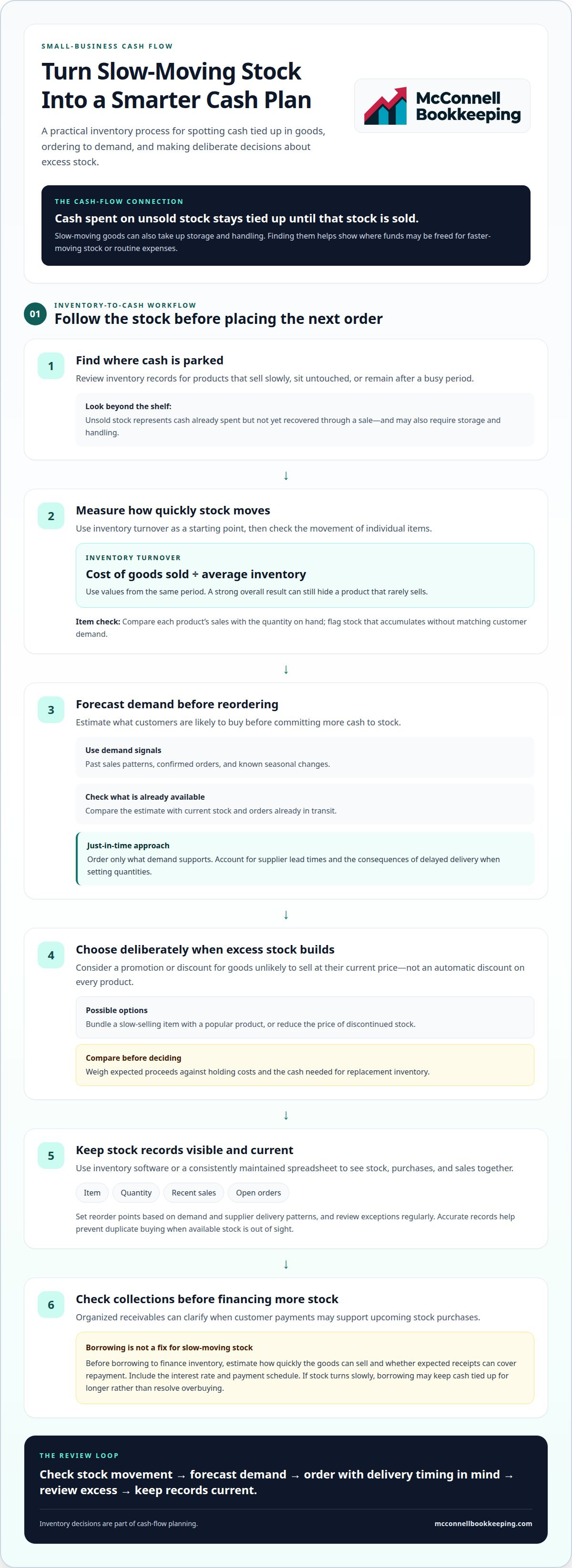
Every unsold product represents cash already spent but not yet recovered through a sale. Review inventory records for items that sell slowly, sit untouched, or remain after a busy period. A product taking up shelf space may also require storage and handling, while the money tied up in it could support faster-moving stock or routine expenses. Improving business cash flow starts with spotting where funds are parked in stock customers aren’t buying.
Use inventory turnover to compare how quickly stock moves. Calculate it by dividing the cost of goods sold by average inventory for the same period. Review the result alongside item-level sales records: a strong overall turnover can still hide a product that rarely sells. Compare each item’s sales with the quantity on hand, then flag stock that keeps accumulating without matching customer demand.
Forecast demand before placing the next supplier order. Use past sales patterns, confirmed orders, and known seasonal changes to estimate what customers are likely to buy. Compare that estimate with current stock and orders already in transit. A just-in-time approach can reduce capital tied up in unsold goods by ordering only what demand supports. Account for supplier lead times and the consequences of delayed delivery when setting order quantities.
When excess stock builds up, consider a promotion or discount to turn it into cash. For instance, bundle a slow-selling item with a popular product, or reduce the price of discontinued stock. Compare expected proceeds with holding costs and the cash needed for replacement inventory. The aim isn’t to discount every product, but to make a deliberate decision about stock unlikely to sell at its current price.
Inventory software can bring stock levels, purchase orders, and sales records into one view. Use it to set reorder points based on demand and supplier delivery patterns, then review exceptions regularly. A spreadsheet can also help if it consistently tracks each item, quantity, recent sales, and open orders. Accurate records prevent duplicate buying simply because staff can’t see what’s already available.
When deciding how to improve business cash flow, don’t let credit obscure an inventory problem. Before borrowing to finance stock, estimate how quickly the goods can sell and whether expected receipts can cover repayment. Include the interest rate and payment schedule. If stock turns slowly, borrowing may extend the time cash remains tied up rather than resolve overbuying.
Pair inventory reviews with a check of customer collections. If unpaid invoices are delaying cash, keeping receivables organized can clarify when customer payments may support upcoming stock purchases.
3. Supplier payment timing
A line of credit offers flexible access to funds, with interest charged only on the amount used. Invoice factoring turns unpaid invoices into immediate cash by selling them at a discount. A merchant cash advance can provide another funding route, but assess its repayment structure and total cost against forecast receipts before committing.
In the United States, businesses may require payment when an invoice arrives or set a due date within 30 days. They may also impose late-payment penalties and follow up on overdue invoices. State the due date and any penalty clearly in the customer agreement and invoice.
Time supplier payments to protect operating cash without missing agreed due dates. Paying too early moves cash out before necessary, while paying on the due date preserves it longer. Electronic payments can help schedule payment on that date. A check may provide a 1-2 day float before funds leave the account, but payment timing should still follow the supplier agreement.
Discuss terms with key suppliers before a cash shortage creates urgency. For example, ask whether an invoice term can move from 30 days to 60 days, or whether a smaller minimum order is possible. Regular communication supports these discussions. A supplier might also offer an early-payment discount, such as paying in 10 days instead of 30. Compare the discount with the value of retaining cash for operating needs.
Customer collections matter just as much. Send invoices as soon as goods or services are delivered, and make the due date and accepted payment methods easy to find. Shorter terms, such as net 15 instead of net 30, can encourage earlier payment when customers agree. For large contracts, deposits or staged invoices can bring cash in during the work rather than waiting until completion.
Early-payment discounts can speed receivables, but calculate their effect before offering them. A business may offer a 2% discount for payment within 10 days. Compare the discount’s cost with the benefit of receiving cash earlier, then apply the offer consistently to eligible invoices. Monitor whether customers actually pay sooner after the change.
Choose a payment method around the timing gap in your forecast. A business credit card can provide 30 days to collect receivables before the cost hits the account, while a line of credit can cover a short-term gap. Both require attention to repayment timing and costs. Factoring provides faster access to invoice cash, but selling receivables at a discount reduces the amount collected.
Review expected customer receipts and supplier due dates together. A simple weekly payment calendar can show when cash may tighten and which conversations to start early. Regular monitoring helps maintain healthy operating cash and makes supplier commitments easier to plan.
4. Cash flow forecasting and scenario planning
Create a forecast by listing expected cash receipts and payments in date order, then compare the projected balance with upcoming obligations. Update it weekly or monthly using current account balances, customer invoices, supplier bills, payroll, and planned expenses. This gives you a working view of when funds should arrive and when they need to leave.
Begin with cash available, then add expected receipts and subtract payments for each period. Record when cash is likely to arrive, not only when sales are recorded. A profitable month can still create a shortfall if customers pay after major expenses fall due. Some customers may take as long as 90 days to pay, so use realistic collection dates. A practical answer to how to improve business cash flow is to plan receipts and expenses around their actual timing.
Keep the forecast useful by separating predictable costs from uncertain ones. Include rent, payroll, debt payments, supplier invoices, and recurring software charges. For each expected sale, estimate its collection date; for each expense, use its due date. Compare the projected balance with upcoming commitments to identify when cash may become tight and what decisions could help.
Start with the actual cash balance and known deposits.
Add expected customer receipts according to invoice timing.
Subtract operating expenses on their anticipated payment dates.
Review the projected balance against upcoming obligations.
Build scenario forecasts to test how changes could affect available cash. One version can use expected sales, while another models a downturn or slower customer payments. A third can account for higher expenses, interest costs, or a delayed project. Comparing these outcomes helps you see how to improve business cash flow before a shortfall affects planned commitments.
External conditions can shift your assumptions. Interest rates, inflation, market volatility, and government policy can affect costs, demand, or financing. Update the forecast when these factors change instead of carrying old assumptions forward. If a known quiet period is approaching, plan cash needs around its expected duration and schedule discretionary spending with care.
Reduce expenses without hurting operations by reviewing each cost’s purpose and effect before changing it. Cancel or downgrade unused software and services, then assess whether rent, utilities, insurance, or frequent supplier purchases offer room for savings. Protect expenses that support essential delivery, customer service, and revenue generation.
Use actual financial reports to test proposed changes before acting. A cash flow statement shows cash from operating, financing, and investing activities, helping distinguish a timing problem from a sustained operating gap. Compare forecast results with actual receipts and payments regularly, then adjust assumptions. This cycle makes forecasting a practical tool for deciding what the business can afford and when.
5. Why cash flow matters to business growth and solvency
Cash flow connects reported performance with a business’s ability to keep operating. An invoice records revenue in the profit and loss statement, but it doesn’t put cash in the bank until the customer pays. If payroll, rent, or supplier bills come due first, even a profitable business can struggle to meet obligations. Track cash timing alongside sales rather than treating profit as cash available to spend.
That distinction shapes solvency and growth. Cash generated by core business functions helps show whether operations can sustain themselves. A healthy balance can support debt payments, investment, expansion, and unexpected expenses. A shortage can force owners to delay purchases, pass up opportunities, or seek financing when time is limited. Cash planning helps protect daily operations and longer-term goals.
Use a few practical measures to connect cash decisions with business priorities:
Track customer invoices from issue through collection, so expected receipts reflect payment timing.
Compare cash from core operations with recurring expenses and debt payments.
Match planned investment to forecast cash availability, rather than relying on sales or profit alone.
Review changes in cash balances and investigate recurring gaps between receipts and bills.
These strategies help distinguish a temporary timing gap from an operating problem. For example, late customer payments may explain a short-term cash squeeze despite steady sales. If receipts consistently fall short of operating costs, review pricing, spending, or the mix of customers and products. Streamline invoice follow-up and use payment schedules that give cash a clearer path into the account.
Tax payments also affect U.S. cash planning. Include applicable payment deadlines in the forecast, and account for lease payments as business expenses that may be deductible in the United States. Set aside funds based on expected obligations so a due payment doesn’t unexpectedly compete with payroll or supplier costs.
Cash flow is not a single measure of success, but it signals whether plans can move forward safely. A company expanding sales may need more cash for inventory, staffing, or delivery before customers pay. Forecast those outflows against expected receipts, then stage commitments where possible. This makes growth decisions more deliberate and helps owners recognize when expansion could put essential payments at risk.
Clear financial statements and reconciled records help owners see whether cash changes come from operations, financing, or investment. Review your business financial statements to understand the movement behind the balance and make your next cash decision with better visibility.
McConnell Bookkeeping
McConnell Bookkeeping helps business owners bring clearer records to cash flow decisions. If account balances, unpaid invoices, or inconsistent books make available cash difficult to understand, Monthly Bookkeeping and Book Clean-up can organize the financial picture. Financial Analysis provides insights to review income, expenses, and cash movement, while support with customer receivables helps you track payments on time.
These services are a practical next step when you need reliable records to assess inventory purchases, plan payments, or prepare a cash flow forecast. Contact McConnell Bookkeeping to discuss the support that fits your business.
Build a clearer path for your next business decision
Cash flow planning is most useful when it informs what you do next, not just what you record. As your business changes, make financial visibility part of routine decision-making: use dependable records to assess whether a new commitment fits your operating needs and growth plans. That gives you a grounded way to decide how to improve business cash flow as priorities shift.
McConnell Bookkeeping supports that visibility through Monthly Bank Reconciliations, Financial Statement Preparation, and Books Cleanup. Organized records can help you understand where your business stands and make the next decision with greater clarity.
Contact McConnell Bookkeeping today to discuss bookkeeping support for your business. With clear information and a considered next step, you can move forward with confidence.
Frequently Asked Questions
What causes cash flow problems for small businesses?
Cash flow problems often arise when customer receipts arrive after essential payments are due. Slow collections, excess inventory, seasonal sales changes, and unexpected expenses can all contribute. To identify the main pressure, compare bank activity with unpaid invoices, stock purchases, payroll, and recurring bills. If the same gap appears repeatedly, separate one-time costs from ongoing operating issues before deciding which cash flow strategy to adjust.
Why Is Improving Your Cash Flow Important?
Improving cash flow helps a business meet obligations while keeping room to act on opportunities. Available cash can help a business handle a delayed project, respond to an unexpected repair, or invest in a promising product without disrupting routine operations. Monitor cash from core activities alongside obligations. If normal operations regularly fail to cover planned outflows, growth may increase financial pressure rather than strengthen the business.
What’s the difference between cash flow and profit?
Profit measures revenue minus expenses over an accounting period, while cash flow tracks money actually received and paid. For example, a retailer may record a profitable sale but have already paid suppliers for the goods, leaving less cash available until the customer pays. Review both measures together: profit helps assess performance, while cash timing shows whether funds are available for current obligations.
What are the best ways to improve small business cash flow?
Start with the causes you can influence. Focus sales efforts on profitable customers, products, or services, and align employee schedules with periods of stronger demand. If commissions apply, paying them after customer receipts arrive can better match outgoing payments to incoming cash. Review these strategies against operating needs before changing them, so a short-term improvement doesn’t undermine delivery, customer relationships, or future revenue.
How can businesses get customers to pay invoices faster?
Make paying simple and reduce avoidable delays. Automated billing can help send invoices on time and limit errors that lead to customer questions. Before beginning work with a new customer, a credit check can help assess payment risk. For ongoing accounts, monitor overdue balances and follow up consistently. A clear process makes it easier to spot slow-paying customers early and respond before unpaid invoices accumulate.
How should businesses manage inventory to free up cash?
Use item-level sales and stock records to identify products that consistently remain unsold. Compare current quantities with recent demand before approving another purchase, and adjust order sizes to reflect what customers are buying. If demand changes, update purchasing plans rather than relying on old sales patterns. This helps avoid tying more cash into slow-moving items while keeping attention on inventory that supports actual sales.
How can businesses negotiate better payment terms with suppliers?
Approach suppliers with a clear view of ordering patterns and expected cash availability. Explain how a proposed payment schedule could fit your purchasing cycle, then discuss terms that support a reliable relationship. If cash is available, compare the value of an offered trade discount with keeping funds for upcoming obligations. Consistent communication and realistic proposals give both sides a clearer basis for planning orders and payments.
What cash flow warning signs should business owners monitor?
Watch for a declining bank balance, growing overdue receivables, repeated reliance on credit, or supplier bills that become harder to pay. Another warning is when forecast receipts no longer cover scheduled outflows, even though sales appear steady. Compare actual balances with expected payments regularly, and investigate changes rather than waiting for a missed payment. A recurring shortfall may point to collection delays, rising costs, or an operating issue.


Comments