E-commerce Bookkeeping Services in Scottsdale: Pricing and Setup

Your e-commerce books are only as clear as the connections between sales, payroll, and bank activity. Getting started with e-commerce bookkeeping services in Scottsdale means gathering sales and payment records, business bank statements, expense details, and payroll information, then organizing them for consistent transaction tracking and reconciliation. The setup depends on how your business records sales and pays expenses.
It’s natural to want a clear picture of the setup and cost before choosing bookkeeping support. Pricing depends on the work involved, including transaction volume, sales channels, payroll needs, and the condition of your existing records. A quote request provides the specific price. This guide explains what information helps you get started, how to track sales and expenses, where payroll records fit, and how regular bank reconciliations and financial reports bring the numbers together.
Table of Contents
E-commerce transaction classification and expense tracking
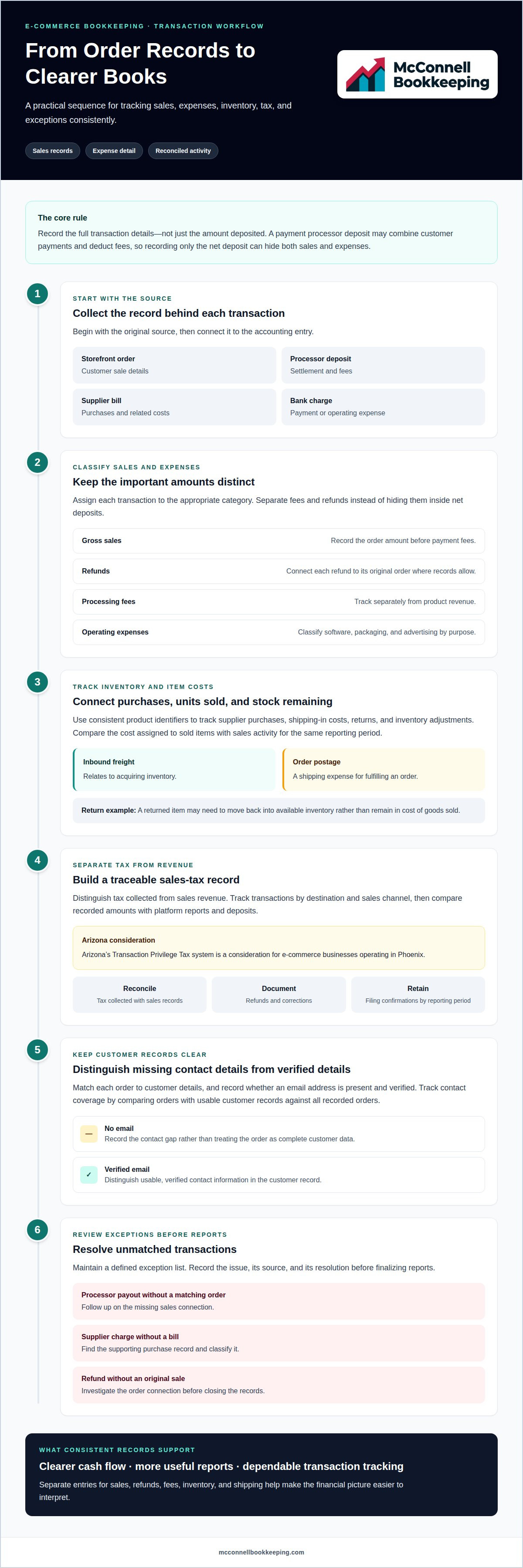
Consistent transaction categories connect each e-commerce sale and expense to useful reports. A practical workflow separates gross sales, refunds, payment processing fees, shipping costs, inventory purchases, and tax collected.
Start with the source record for each transaction: a storefront order, payment processor deposit, supplier bill, or bank charge. Assign it to the appropriate accounting category, then make sure refunds and fees aren’t hidden in net deposits. For example, a processor deposit may combine customer payments and deduct fees. Recording only the net deposit can obscure both sales and expenses. Separate entries make cash flow easier to understand.
Sales: Record the order’s gross amount before payment fees.
Refunds: Connect each refund to the original order where records allow.
Fees: Track processor charges apart from product revenue.
Operating expenses: Classify software, packaging, and advertising by purpose.
Inventory and Cost of Goods Sold Tracking
Inventory records connect product purchases with units sold and stock remaining. Track supplier purchases, shipping-in costs, returns, and adjustments using consistent product identifiers. Then compare the cost assigned to sold items with sales activity for the same reporting period. For example, a returned item may need to move back into available inventory rather than remain in cost of goods sold.
Keep shipping categories distinct. Inbound freight relates to acquiring inventory, while postage to fulfill an order is a shipping expense. Separating them helps show whether product costs or delivery activity is affecting margins. SKU-level records also help explain differences between inventory quantities and accounting balances.
Sales Tax Tracking and Filing
Tax records should distinguish tax collected from sales revenue. Track transactions by destination and sales channel, then compare the amounts recorded with platform reports and deposits. Arizona’s Transaction Privilege Tax system is a consideration for e-commerce businesses operating in Phoenix. Keep calculations, adjustments, and filing records organized by the relevant reporting period.
Preparing filing records starts with complete transaction data, not a single deposit total. Reconcile tax collected with sales records, document refunds or corrections, and retain filing confirmations with the records for the relevant period. These steps create a clearer trail from checkout calculations to reported amounts.
Customer records also affect transaction clarity. Match each order to customer details, and record whether an email address is present and verified. Track contact coverage by comparing orders with usable customer records against all recorded orders. For example, distinguish an order with no email from one with a verified address instead of treating both as complete customer data.
Finally, review unmatched transactions as a defined exception list. A processor payout without a matching order, a supplier charge without a bill, or a refund without an original sale needs follow-up before reports are finalized. Recording the issue, its source, and its resolution keeps e-commerce expense tracking consistent and supports more dependable cash-flow decisions.
Accounts payable, bill pay, accounts receivable, and invoicing
E-commerce businesses need clear records for supplier bills and customer payments. A consistent process connects each invoice, payment, and bank entry to the accounting records.
Accounts Payable and Bill Pay
Accounts payable tracks what the business owes, who should be paid, and whether payment cleared. A workable bill-payment process records the supplier, invoice date, due date, category, and payment status. For example, match a packaging supplier’s invoice to the later bank withdrawal. This link helps prevent duplicate entries and makes upcoming cash needs easier to see.
Review bills for missing details before recording them. A bill without a supplier name or clear purpose can be difficult to classify later. Keep approval notes and payment confirmations with the corresponding invoice. This gives owners a useful record when reviewing expenses or investigating differences between the accounting system and bank activity.
Accounts Receivable and Invoicing
Accounts receivable tracks customer balances from invoice creation through payment. Each invoice should show the customer, sale, amount due, and payment status. If a customer pays part of an invoice, apply the partial payment to that balance. This prevents the remaining amount from appearing settled and helps focus follow-up on genuinely unpaid invoices.
For online orders paid at checkout, match sales records to processor settlements rather than creating duplicate customer invoices. For example, a Stripe payout may cover multiple orders and subtract processing fees. Keep the sales details connected to the payout record so the books reflect both customer payments and the amount deposited.
Bookkeeping support for e-commerce businesses in Scottsdale can include monthly bookkeeping, bank reconciliations, book clean-up, and QuickBooks Online training. McConnell Bookkeeping also manages accounts payable and accounts receivable. Together, these services help organize vendor obligations, customer balances, and accounting records without treating every platform deposit as a separate sale.
Shopify, Amazon, Stripe, and QuickBooks may connect through available data feeds or platform reports. The bookkeeping workflow should identify which system holds each record, then match imported sales and settlements against accounting entries. A general bookkeeper unfamiliar with ecommerce records may overlook processor fees, refunds, split payouts, or duplicate sales entries. Those errors can distort income and leave bank differences unresolved.
Monthly account reconciliation compares recorded transactions with bank and payment processor activity. For example, an unmatched deposit may be a payout combining several orders, while an unrecorded bank withdrawal may relate to a supplier bill. Documenting each match and investigating exceptions helps keep monthly records current and gives owners a clearer view of cash flow.
A defined accounts payable and receivable workflow can also make business growth easier to monitor. Review bookkeeping workflows to see how organized bills, invoices, and reconciliations support reliable accounting records.
Financial statements, KPI dashboards, and cash flow forecasting
Financial reports turn recorded e-commerce activity into a view of business performance. A monthly review can connect the income statement, balance sheet, and cash flow statement, then surface questions that daily sales totals cannot answer. For example, marketplace revenue may rise while available cash falls if fees, inventory purchases, or payment timing also change.
The income statement summarizes revenue and expenses for a chosen period. The balance sheet shows assets, liabilities, and equity on a specific date. A cash flow statement groups cash movements by operating, investing, and financing activity. Read together, these reports help owners distinguish profitability from available cash. Accurate reporting also depends on complete records and consistent transaction classifications.
A KPI dashboard should focus on measures that guide operational decisions, not simply display more figures. E-commerce examples include gross margin, refund rate, average order value, and inventory turnover. A marketplace report can show sales by channel, while accounting records capture expenses and deposits. Compare each measure across consistent reporting periods, then investigate changes before treating them as a trend.
Gross margin: Compare revenue with the related cost of goods sold.
Refund rate: Review refunds against sales for the same period.
Average order value: Track sales value per order over time.
Inventory turnover: Compare product costs with inventory levels and sales activity.
Monthly financial statements create a repeatable review point. First, close the period by recording transactions and resolving unmatched entries. Next, compare changes with the prior period and note unusual movements, such as a large advertising expense or seasonal inventory purchase. Finally, connect each dashboard measure to the underlying accounts so an owner can trace an unexpected result to its source.
Multi-platform reporting brings storefront, marketplace, payment processor, and accounting data into a consistent view. Shopify sales and Amazon marketplace activity, for example, may need separate channel labels before appearing in combined reports. Keep gross sales, refunds, fees, and payouts distinguishable; otherwise, a net deposit can conceal how each channel performed. Recording the source of each import also helps explain differences between platform totals and accounting balances.
Cash flow forecasting turns expected receipts and payments into a forward-looking view. Start with available cash, then map expected customer settlements, supplier bills, payroll, and planned inventory orders. A delayed marketplace payout can change the timing even when recorded sales remain steady. Build scenarios around specific operational choices, such as postponing a purchase or increasing ad spend, and compare their effects on available cash.
CFO-level forecasting adds planning and interpretation to historical reports. It can help owners test assumptions about pricing, hiring, and channel expansion before committing resources. Businesses seeking GAAP-based reporting should clarify the intended reporting basis and the consistency required across statements. This helps align financial reports with their purpose, whether for internal planning, lender review, or another business decision.
Bookkeeping service pricing
Bookkeeping pricing reflects the records, platforms, and reporting a business needs. The price depends on the work involved and is provided after a quote request. For a Shopify store, the quote may account for sales activity, refunds, processor deposits, expense records, and reporting needs. An Amazon seller may have different marketplace records and payout details to organize. The workload behind the records matters more than the storefront name alone.
Transaction volume is one factor, but complexity also shapes the work. A business with several sales channels may need separate records for each, while a single-channel store may have fewer data sources. Refunds, partial payouts, inventory activity, and manual adjustments can all require additional review. Clear source records make bookkeeping more efficient because fewer entries need investigation or correction.
Service scope also affects the estimate. Some businesses need routine transaction recording and account reconciliation; others need book clean-up before regular monthly work can begin. Financial statement preparation, accounts payable, accounts receivable, or payroll management may involve distinct tasks. A quote should connect each requested task to its frequency and deliverable so the business can understand what the service covers.
Records: Consider the condition and organization of existing books.
Channels: Identify storefronts, marketplaces, processors, and bank accounts involved.
Workflows: Note invoicing, bill tracking, payroll, and reconciliation needs.
Reporting: Define the statements or management views needed.
A clear service plan describes the agreed work in plain terms. It can specify which accounts are reviewed, which records feed the books, and how often reports are prepared. For example, a plan may distinguish monthly reconciliation from one-time clean-up. This helps prevent a setup project from being confused with ongoing bookkeeping and gives owners a practical basis for comparing the plan with their operating needs.
A service plan should follow business activity, not a generic package label. A growing seller might add a marketplace, start issuing invoices, or hire employees. Each change can alter the records and review steps required. Revisit the scope as operations change so the process continues to match the business and new transactions remain part of the regular workflow.
Before requesting a quote, organize the details that explain the workload: sales channels, accounting system, bank accounts, transaction records, reporting preferences, and any clean-up needs. Shopify and Amazon reports can help show how sales and payouts are recorded. A clear overview supports a tailored estimate and makes it easier to identify whether the next priority is setup, ongoing bookkeeping, or resolving older entries.
Pricing is most useful when tied to a defined outcome. Ask what records are included, how exceptions are handled, and which reports the plan produces. Those details help an e-commerce owner understand the service rather than relying on a headline price alone.
Payroll integrations and bank reconciliations
Payroll records and bank activity need to agree before reports can show a reliable balance. A connected workflow links payroll summaries, payroll-related withdrawals, and accounting entries, making labor costs easier to understand alongside profit.
Start with the payroll system’s summary for each pay run. Separate gross wages, employee deductions, employer costs, and net pay in the accounting records. The payroll summary provides detail; the bank statement shows what actually cleared. Matching both records helps identify whether an entry reflects wages, a tax withholding, a benefit deduction, or another payroll-related payment.
Payroll integrations can transfer summarized data into an accounting system. If direct integration isn’t part of the workflow, a structured export can still provide the source details. The key is to map each payroll category to its intended account and review imported entries. A mapping error could place employee deductions among operating expenses or combine separate costs, making labor reports less useful.
Payroll summary: Use the period’s report to identify recorded payroll components.
Accounting entry: Map wages, deductions, and employer costs to appropriate accounts.
Bank activity: Match withdrawals to the related payroll records.
Open differences: Document timing gaps or entries needing correction.
Bank reconciliation tests whether recorded activity matches the bank’s posted transactions. For example, a payroll summary may show one net-pay amount while the bank statement contains separate withdrawals for employee payments and payroll-related transfers. Match each withdrawal to its supporting record instead of forcing different amounts into one entry. This preserves detail and makes the remaining balance easier to explain.
Treat timing differences clearly. A payroll entry recorded near the end of a reporting period may clear the bank afterward. Keep the entry identifiable as outstanding, then match it when the withdrawal appears. If an amount differs, compare the payroll report, payment confirmation, and bank entry before changing the books. This helps distinguish a timing difference from a recording error.
Reconciliation also tests payroll-related account balances. Compare amounts recorded as owed or withheld with supporting payroll summaries and subsequent payments. Investigate old balances, duplicate entries, and unassigned withdrawals. Documenting the resolution gives owners better guidance about labor costs and protects profit reports from unexplained fluctuations.
For a useful close, connect the reconciled bank activity back to the payroll period and financial statements. This makes it clearer whether changes in labor expense reflect staffing, pay activity, or a posting issue. Get support with payroll management and bank reconciliations to bring these records into a consistent bookkeeping workflow.
McConnell Bookkeeping
McConnell Bookkeeping helps business owners organize financial records and gain a clearer view of business activity. If sales records, customer balances, or bank activity need attention, Books Cleanup and Accounts Receivable Management can support more complete bookkeeping. Monthly Bank Reconciliations help connect recorded activity with bank statements, while Financial Statement Preparation turns organized records into useful reports.
These services are a practical next step when e-commerce activity makes records harder to maintain or when you need consistent financial information for business decisions. The focus is on organized records and reporting, giving you a more dependable foundation for reviewing operations.
Contact McConnell Bookkeeping to discuss your bookkeeping needs.
Build a clearer path for your next stage
Your bookkeeping setup should support upcoming decisions, not just record yesterday’s sales. As your store changes channels, adjusts inventory, or expands payroll, consistent records can help you see how those choices affect day-to-day operations. Choosing e-commerce bookkeeping services in Scottsdale is an opportunity to establish a process that keeps financial information useful as your business evolves.
McConnell Bookkeeping can help organize records through Books Cleanup, keep bank activity aligned with Monthly Bank Reconciliations, and prepare Financial Statements that support informed business decisions. These services create a practical foundation for reviewing performance and planning your next steps, with the work focused on your bookkeeping needs.
Contact McConnell Bookkeeping today to discuss a clear, dependable bookkeeping process for your business. With organized records and thoughtful financial oversight, you can move forward with greater confidence.
Frequently Asked Questions
What are the requirements to get started?
Start with access to your accounting system and organized business records. Gather recent bank statements, sales and payout reports, supplier bills, payroll summaries, and details about each sales channel. For example, a seller using Shopify and a payment processor can provide reports from both, along with matching bank activity. A clear list of business accounts and reporting needs helps establish a practical bookkeeping workflow.
What bookkeeping do you do for me?
McConnell Bookkeeping provides Monthly Bookkeeping, Book Clean-up, Payroll Services, and Financial Analysis. Monthly Bookkeeping includes transaction recording and bank reconciliations; Book Clean-up reviews past transactions and resolves discrepancies. Payroll Services handles payroll processing, while Financial Analysis provides data to support business decisions. The work uses QuickBooks Online to keep financial records organized and useful for managing a small business.
Which Scottsdale bookkeeping firms specialize in Shopify, Amazon, Etsy, or WooCommerce?
McConnell Bookkeeping serves small businesses in the Scottsdale area and uses QuickBooks Online for bookkeeping. For a seller using Shopify, Amazon, Etsy, or WooCommerce, the essential workflow is to keep each channel’s sales and payout records identifiable in the accounting system. This helps owners understand where recorded activity originated. The firm’s services focus on bookkeeping, payroll, clean-up, and financial analysis.
How much do e-commerce bookkeeping services cost in Scottsdale?
The price depends on the work involved and is provided after a quote request. Costs depend on factors such as the number of sales channels, transaction complexity, the condition of existing records, and the reporting or payroll work required. For example, a store with several payout sources and older records needing clean-up may need a different scope than a single-channel business with organized books.
What bookkeeping services do e-commerce businesses typically need?
E-commerce businesses often need transaction recording, bank reconciliations, payroll processing, clean-up, and financial analysis. The right mix depends on how the business operates. A seller with organized current records may need recurring bookkeeping, while a business with unexplained historical balances may first need clean-up. Regular financial analysis can also help owners get clearer information for planning inventory, staffing, or channel decisions.
How do Scottsdale e-commerce bookkeepers handle sales tax and Arizona TPT filings?
Bookkeeping can organize sales summaries and amounts recorded as tax collected, while filing is a separate task. Keep platform reports and accounting records aligned so sales activity can be reviewed by channel and period. Arizona TPT filing requirements depend on the business’s situation, so bookkeeping records alone do not show that a filing has been completed. McConnell Bookkeeping focuses on bookkeeping and financial records.
What should I compare when choosing an e-commerce bookkeeper in Scottsdale?
Compare the bookkeeping workflow, accounting system, reporting deliverables, and services included. McConnell Bookkeeping uses QuickBooks Online and provides Monthly Bookkeeping, Book Clean-up, Payroll Services, and Financial Analysis. For a Scottsdale seller, a useful fit is a process that keeps records organized as sales channels or operations change. Identify the work that supports your immediate need, such as resolving past discrepancies or maintaining current records.
What monthly sales volume or transaction count affects bookkeeping pricing?
Pricing depends on the workload, not a universal sales or transaction threshold. Transaction count matters because it affects the volume of records to process, while complexity matters when orders create split payouts, refunds, or multiple channel reports. A business with fewer but less organized transactions may need substantial clean-up. Pricing is provided after a quote request based on the work involved.



Comments