Bookkeeping for Overwhelmed Owners: Decide What to Tackle First

The fastest way to regain control of bookkeeping for overwhelmed business owners is to tackle the records that affect decisions and cash flow first, not to catch up on everything at once. Start by checking recent bank and credit card activity, money clients owe you, and bills coming due. Then set aside 15 to 30 minutes weekly to keep records current and spot issues sooner.
Falling behind doesn’t mean you’re careless. Financial tasks compete with the work of running a business, and they can become more complex as activity grows. But outdated books make it harder to tell whether expenses are rising, income is keeping pace, or cash is available for upcoming obligations. This article explains why bookkeeping slips down the list, how gaps can cloud decisions, and what to prioritize now, from recording transactions to reconciling accounts and organizing overdue records. You’ll have a clear starting point, even if the backlog feels daunting.
Table of Contents
1. Outdated financials and business decisions
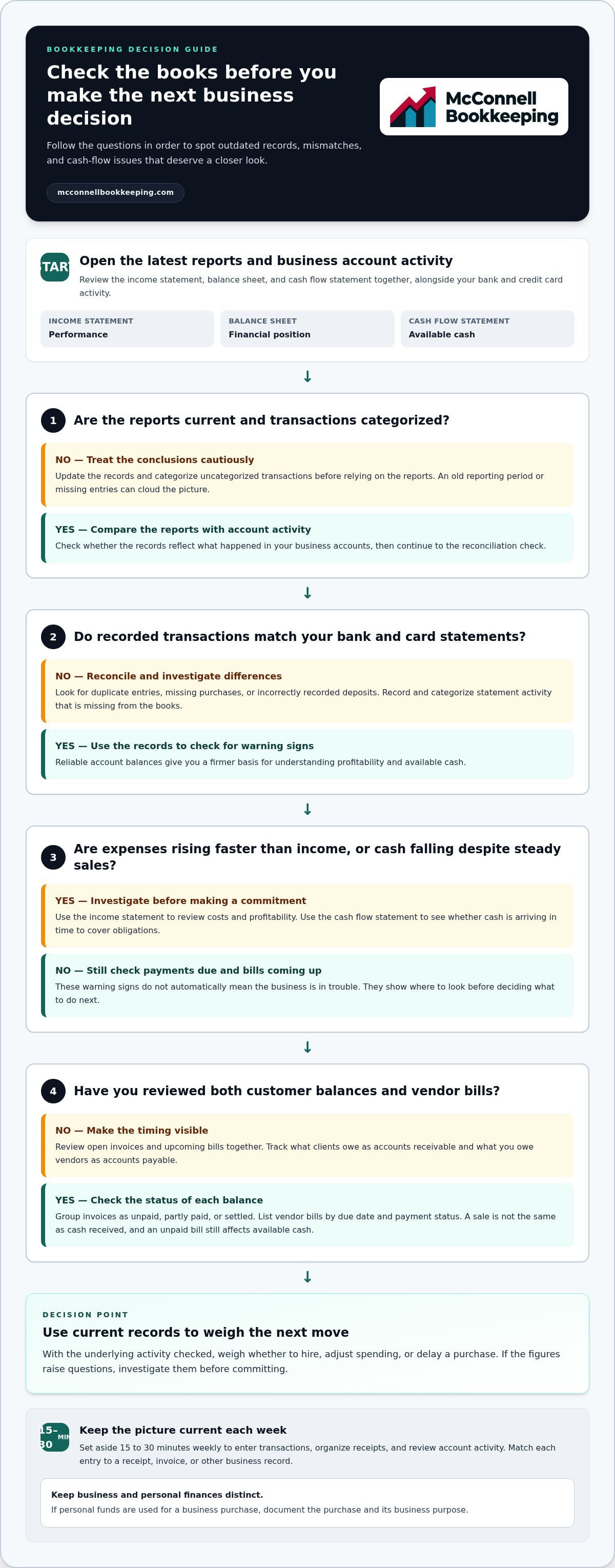
Outdated books make everyday decisions harder because they hide what is happening inside the business. Review the income statement, balance sheet, and cash flow statement together. Each shows a different part of the picture: performance, financial position, and available cash.
For example, steady sales can disguise rising expenses or shrinking cash reserves. An income statement can show whether costs are reducing profitability, while a cash flow statement helps reveal whether cash is arriving in time to cover obligations. Keeping these records current gives decisions a firmer foundation.
To see how the core bookkeeping pieces fit together, watch this beginner-friendly overview:
Start with a practical review. Open your latest reports and compare them with activity in your business accounts. If a report covers an old period or transactions remain uncategorized, treat its conclusions cautiously. Clear, current records give you a sounder basis for deciding whether to hire, adjust spending, or delay a purchase.
Keep business and personal finances separate. Use a dedicated business account for company income and expenses, and record any personal funds used for business distinctly. For example, if you pay for supplies with a personal card, document the purchase and its business purpose. Mixing transactions makes it harder to identify actual business costs and interpret reports.
Consistent record-keeping supports that clarity. Set aside 15 to 30 minutes weekly to enter transactions, organize receipts, and review account activity. Match each entry to a receipt, invoice, or other business record. A repeatable routine makes unusual transactions easier to spot than relying on memory at month-end.
Look for expenses rising faster than income.
Check whether cash balances are falling despite steady sales.
Review overdue customer payments and bills coming due.
Investigate uncategorized transactions or balances that do not match account activity.
These warning signs don’t automatically mean a business is in trouble. They show where to investigate before making a commitment. If the reports are difficult to interpret, accurate financial statement preparation can organize the figures into a clearer picture. Reliable information helps owners weigh choices using their actual financial position, not assumptions or an outdated snapshot.
Business owners who manage their own books may miss warning signs such as declining profitability or rising expenses. Organized, accurate records help make the business’s financial picture clearer and provide information owners can rely on. Reviewing that information before acting helps distinguish a decision grounded in current records from one based on assumptions or an old snapshot.
Clear bookkeeping can help business owners make decisions with greater confidence. It doesn’t make the choice for them; it provides a sounder basis for weighing whether to hire, change spending, or delay a purchase. If the figures raise questions, investigate them before committing, and keep the underlying records current so the next review is useful too. A consistent approach supports decisions based on the business’s actual financial position, not uncertainty about what the books contain.
2. Tracking cash transactions and accounts payable and receivable
The cash flow statement tracks cash moving into and out of your business. Pair it with the income statement, which shows revenue and expenses, to assess profitability alongside available cash. Together, these reports help answer whether sales are producing profit and whether cash can cover upcoming payments.
Uncertainty grows when a sale, customer payment, or cash purchase never reaches your accounting records. Record every transaction, including cash purchases, just as you would a debit or credit card purchase. For example, enter a cash-paid supply expense with its date, business purpose, and supporting receipt. This record helps distinguish actual spending from estimates based on memory.
Next, compare bookkeeping entries with bank and credit card statements. Reconciliation means checking that recorded transactions match the statements, then investigating differences such as duplicate entries, missing purchases, or incorrectly recorded deposits. This step makes the balance in your records more dependable. If a payment appears on a statement but not in your books, record and categorize it before relying on reports.
Cash flow management also depends on tracking both sides of unpaid activity. Accounts receivable shows what clients owe your business; accounts payable shows what your business owes vendors. A sales invoice is not the same as cash received, and an unpaid vendor bill still affects the money available for other needs. Review open invoices and upcoming bills together to understand the timing gap.
Record cash, card, and bank transactions with clear descriptions.
Match deposits to customer invoices, rather than treating every deposit as new sales.
Compare vendor bills with payments, so unpaid balances remain visible.
Update invoice and bill statuses after each payment or collection.
For a practical view, group receivables by status, such as unpaid, partly paid, or settled. Then list vendor bills by due date and payment status. These categories show which expected payments haven’t arrived and which obligations need attention. If clients owe more than expected, follow up on specific invoices and update their records when payment arrives.
Use the information to plan, not just to describe past activity. Before approving a purchase, compare its timing with expected customer payments and vendor due dates. A positive profit figure alone doesn’t show whether cash is available on the payment date. Owners who need help keeping customer balances organized can explore accounts receivable management as a way to improve visibility into outstanding invoices.
3. Putting off bookkeeping and the costs of late records
With each week that records wait, details become harder to recall. A business owner may forget whether a purchase was inventory, a client expense, or personal spending. That uncertainty can lead to misclassified transactions, inaccurate reports, missed deductions, and more difficult tax-season preparation. Update expenses as they happen instead of rebuilding the story later.
Keep records supporting reported income, expenses, deductions, and credits, including receipts, invoices, bank statements, and payment records. IRS record-retention periods depend on the document and circumstances, so no single period fits every business record. Organize documentation by tax year and transaction type so each entry can be connected to its supporting evidence.
Make one simple system for digital and paper documents. For each expense, save the receipt with the date, amount, vendor, and business purpose. Attach an invoice to its payment record, then mark whether it remains unpaid or settled. A clearly named folder such as “2026 expenses” is more useful than a camera roll full of unlabeled receipt photos.
File customer invoices with payment details and current status.
Keep vendor bills beside proof of payment.
Save receipts for purchases, especially tax deductions over $75.
Store bank statements and transaction records by account and period.
Record every business transaction, not only card purchases or deposits. Include cash sales, cash purchases, owner contributions, refunds, and transfers between business accounts. For example, a cash purchase needs an entry and receipt, while a transfer between accounts should not be mistaken for new income. Documenting the purpose prevents gaps and misleading totals.
Common mistakes include leaving transactions uncategorized, mixing personal and business spending, entering purchases from memory, and recording an invoice as paid before payment arrives. These habits can distort reports and contribute to tax errors. Before closing the period, compare each entry with its receipt, invoice, or account record.
Consistency limits the work needed for future cleanup. Set a weekly or biweekly time to upload documents, enter expenses, and follow up on missing records. If a backlog already exists, organize it by account and period, then work forward from the earliest incomplete records. This sequence helps reveal missing statements and duplicate entries before they carry into later reports.
Delaying review can lead owners to avoid their financial numbers, adding stress later. Inconsistent records can obscure financial health and contribute to cash flow problems or missed payments. Disorganized records may also heighten concern about penalties or fines in an audit. Small businesses benefit from regular bookkeeping to keep records current and catch errors early.
Stress and uncertainty caused by overdue books
Overdue books create a mental load beyond the time spent entering transactions. An owner may delay a hiring decision because cash balances feel uncertain, or postpone reviewing expenses because the records seem difficult to face. A short, scheduled review gives the task a clear beginning and end.
A simple bookkeeping system for a solo business owner uses a dedicated business account, one consistent recordkeeping method, organized receipt storage, and regular reconciliation. Set a weekly time to record transactions and match account activity so missing details don’t accumulate.
Tax compliance can feel more stressful when income, expenses, and supporting documents are scattered. A receipt in an email, an invoice in a folder, and an uncategorized transaction in accounting software make clear records harder to prepare. Connecting each document to its transaction creates a more usable trail.
Build a routine that reduces decisions about what to do next. Set aside 15 to 30 minutes weekly, then follow the same sequence: enter transactions, attach documents, review unusual items, and reconcile accounts. A repeatable process turns a large, vague backlog into smaller tasks with visible progress.
Use one dedicated business account for business activity.
Save receipts and invoices in folders organized by period.
Record transactions with clear descriptions and categories.
Reconcile account activity and flag items needing follow-up.
Reconciliation can also reduce uncertainty. Compare records with bank statements and investigate differences, such as a duplicate entry or an unrecorded payment. Resolve the difference or note what needs attention. This gives you a specific next step instead of leaving a vague concern about whether the books are accurate.
For tax preparation, keep income records, expense documentation, invoices, and account statements together by tax year. Don’t rely on memory to explain a purchase months later. If a transaction lacks a clear business purpose or supporting document, mark it for review while the details are easier to recall.
If overdue work feels too large, define a small starting point. Choose one account and one period, gather its statements, then match recorded activity to the source documents. Continue through the remaining periods in order. A weekly review of 15 to 30 minutes can then help maintain the progress and catch gaps before they become a larger source of stress.
You don’t need perfect records to begin. You need a repeatable place for each transaction, a routine for reviewing it, and a clear way to identify unresolved items. These practical steps make financial information easier to use and reduce the uncertainty that can follow overdue bookkeeping.
5. Why small business owners fall behind on bookkeeping
Bookkeeping often falls behind when customer work, scheduling, and daily operations take priority. An owner may postpone categorizing expenses after a demanding week, then find the unfinished task competing with new work. The cause is often a crowded workload, not indifference to the numbers.
Growth adds more moving pieces. More clients can mean more invoices, payment records, accounts, and transactions to classify. A solo consultant might begin with a few monthly invoices, then add contractors, projects, and payment channels. The old bookkeeping routine may no longer cover the business’s activity.
Software can organize transactions, but unfamiliar features may create errors or waste time. A transaction imported twice or assigned to the wrong category needs correction before reports can be trusted. Learn the basic workflow for entering, categorizing, and correcting transactions, then document any steps that are easy to forget.
Small business bookkeeping software costs vary by plan, features, users, and add-ons. Compare the tools included with the work you need, such as transaction tracking, invoicing, and reporting, rather than choosing a plan based only on its name.
Reliable bookkeeping for overwhelmed business owners depends on a regular cadence. Each week, record transactions and organize receipts. Each month, reconcile accounts and review income and expense reports. At year-end, organize records and review totals in preparation for tax work. A defined schedule makes each task easier to fit around daily responsibilities.
Start with a weekly block of 15 to 30 minutes. Use a checklist instead of deciding from scratch: enter transactions, attach documents, and note unresolved items. If the work consistently takes longer, identify the bottleneck. Missing receipts, unclear categories, or unfamiliar software steps each call for a different fix.
Save documents as transactions happen, rather than searching later.
Use consistent categories for recurring income and expenses.
Keep unresolved entries on a list with the details needed to finish them.
Review the routine monthly and adjust it as business activity changes.
Bookkeeping for overwhelmed business owners becomes more manageable when the process fits the business as it operates now. If invoice volume has grown, for example, manual follow-up may compete with transaction entry. Separate the work into clear steps, then decide which tasks you can maintain consistently and which need dedicated support.
The useful takeaway is to address the cause of the backlog, not just the old entries. A recurring schedule can help with time pressure, while software training can clarify repeated tasks. Choose one point of friction and improve that process before adding tools or steps.
McConnell Bookkeeping: Monthly Bank Reconciliations
McConnell Bookkeeping provides monthly bank reconciliations to help match recorded activity with account statements and identify discrepancies. If overdue entries or unexplained balances make it difficult to rely on your numbers, reconciliations can bring your records into clearer order.
For owners facing a backlog, McConnell Bookkeeping’s Book Clean-up helps organize past transactions. Financial Analysis can then turn organized records into insights that support business decisions. If unpaid customer invoices are also affecting cash visibility, Accounts Receivable Management can help keep those balances organized.
Choose support that fits your immediate bookkeeping challenge, whether you need to restore order or maintain reliable monthly records. Contact McConnell Bookkeeping to discuss a practical next step for your business.
Choose a Clear Next Step for Your Books
Progress starts by choosing the bookkeeping task that would make your next business decision clearer. Instead of fixing every record at once, identify the main obstacle: unclear balances, disorganized entries, or reports you can’t confidently use. That choice gives you a practical place to begin and makes the work easier to approach.
A manageable approach to bookkeeping for overwhelmed business owners starts with the support that addresses the current obstacle. McConnell Bookkeeping offers Books Cleanup, Monthly Bank Reconciliations, and Financial Statement Preparation. Cleanup organizes historical records, reconciliations compare recorded activity with account statements, and prepared statements make financial information easier to review. Effective bookkeeping for overwhelmed business owners begins with choosing the service that fits the immediate need.
You don’t have to solve every bookkeeping challenge before moving forward. Choose the work that would bring the most clarity to your business, then build from there. Explore bookkeeping support with McConnell Bookkeeping and take a steady, informed step toward more manageable records.
Frequently Asked Questions
So What Can You Do (Right Now)?
Choose one current problem and take a small, specific action today. If you’re unsure whether a bill is paid, locate its invoice and compare it with your account activity. If a report looks unreliable, identify the period or account with missing entries. Write down unresolved questions as you find them instead of interrupting each task to investigate every detail. This gives your next bookkeeping session a focused starting point.
How much do outsourced bookkeeping services cost for small businesses in the U.S.?
The price depends on the case and is provided after a quote request. Cost factors include transaction volume, the number of accounts, the state of existing records, and the work required for ongoing bookkeeping or cleanup. A business with organized current records has different needs from one with several periods of unclassified activity. Define the support you need, such as reconciliations or statement preparation, so the scope can be understood.
Bookkeeping software vs. hiring a bookkeeper: which is best for a small business?
Software can suit owners who have time to enter transactions, understand categories, and review reports consistently. A bookkeeper may be a better fit when the workload competes with customer work, records need cleanup, or reports are difficult to interpret. Some owners use both: software stores transactions, while a bookkeeper helps organize and review the records. For example, a Mesa business owner might manage routine entries and seek support when account balances stop matching.
What records should small businesses keep, and for how long, under IRS rules?
Keep receipts, invoices, bank statements, and payment records supporting reported income, expenses, deductions, and credits, organized by tax year and transaction type. IRS retention periods depend on the document and circumstances, so there is no single period for every business record.



Comments