Arizona payroll requirements for small business: Employer taxes and costs

Arizona payroll has state-specific rules, and small businesses must account for both state and federal obligations. Arizona payroll requirements for small business owners include state income tax withholding, unemployment insurance, and federal payroll taxes; Arizona’s flat state income tax rate is 2.5% of employees’ gross taxable wages in 2026. The right withholding approach can also depend on how much tax you withhold and where your employees work.
It’s understandable to want a clear answer about which rules apply, especially when payroll includes remote or out-of-state staff. This guide covers employer taxes and costs, Arizona unemployment insurance registration and quarterly wage reporting, and withholding when employees work from different locations. Understanding Arizona payroll requirements for small business operations helps you organize filing schedules and payroll records. With these obligations mapped out, each payroll run is easier to manage.
Table of Contents
How do Arizona employers handle withholding for remote or out-of-state employees?
Arizona employers handle state income tax withholding alongside federal payroll taxes, with filing schedules based on withholding amounts. Remote workers add a location factor: keep accurate records of where each employee works so you can apply the relevant withholding rules.
For a practical overview of Arizona business pay options, watch this video:
Arizona Income Tax Withholding
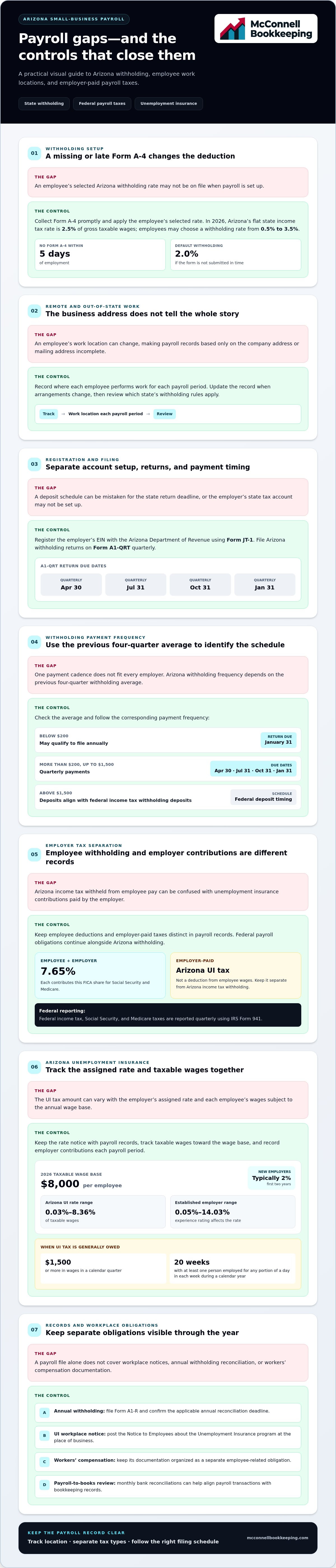
Arizona income tax withholding is the amount an employer deducts from employee wages for state income tax. In 2026, Arizona’s flat state income tax rate is 2.5% of gross taxable wages, while employees may select a withholding rate from 0.5% to 3.5% on Form A-4. If a new employee doesn’t submit Form A-4 within five days of employment, the employer must withhold at the default rate of 2.0%. Collecting the form promptly helps align each paycheck deduction with the employee’s selection.
Withholding Registration and Returns
Withholding registration establishes an employer’s state tax account so it can report and remit Arizona income tax withheld from employee wages. Arizona employers must register their EIN with the Arizona Department of Revenue using Form JT-1. Employers file Form A1-QRT quarterly, with returns due April 30, July 31, October 31, and January 31. Separating return filing from payment scheduling helps prevent a deposit schedule from being mistaken for the return deadline.
Remote work calls for clear payroll records. Record where each employee performs work and update the information when their arrangement changes. For example, an employee who moves from an Arizona workplace to an out-of-state home office may require a different withholding review. Track the work location for each payroll period, rather than relying only on the business address or the employee’s mailing address.
Arizona withholding payment frequency depends on the employer’s previous four-quarter withholding average. Employers averaging below $200 may qualify to file annually, with the return due January 31 of the following year. If the average is more than $200 and no more than $1,500, payments are quarterly, due April 30, July 31, October 31, and January 31. Above $1,500, deposits align with federal income tax withholding deposits.
Federal obligations continue alongside state withholding. U.S. employers report federal income tax, Social Security, and Medicare taxes quarterly using IRS Form 941, according to the Internal Revenue Service. Employees and employers each contribute a 7.65% FICA share, covering Social Security and Medicare. Keep these federal calculations distinct from Arizona income tax so payroll records show each withholding and employer contribution accurately.
Arizona employers also file an annual withholding reconciliation, Form A1-R. Employers should confirm the applicable annual reconciliation deadline and plan their filing accordingly. Matching annual wage and withholding totals against quarterly filings helps identify differences before the reconciliation deadline and supports consistent payroll compliance.
Arizona unemployment insurance tax
Arizona unemployment insurance tax helps fund benefits for eligible workers who lose employment. Understand how your rate, taxable wages, and workplace obligations affect payroll costs.
State Unemployment Rates and Wage Base
Arizona’s unemployment insurance rate applies to taxable employee wages, up to the state’s annual wage base. In 2026, that wage base is $8,000 per employee. Rates range from 0.03% to 8.36% of those wages, while established employers’ rates range from 0.05% to 14.03%. Your assigned rate affects the employer’s state payroll tax cost, so keep the notice setting that rate with your payroll records.
Unemployment Insurance Contributions
Unemployment insurance contributions are employer-paid state payroll taxes, not deductions from employee wages. New Arizona employers typically pay a 2% rate for their first two years; after that, the business’s experience rating affects its rate. Employers generally owe UI tax if they pay at least $1,500 in wages in a calendar quarter or employ at least one person for any portion of a day in each of 20 different weeks during a calendar year.
These thresholds help determine whether an employer must pay state unemployment tax. This is separate from Arizona income tax withholding, which is deducted from employee pay. Keep UI contributions separate in payroll records so employer-paid taxes aren’t mixed with employee withholding. A clear ledger entry for each payroll period also makes it easier to compare tax calculations with total wages paid.
The unemployment insurance program also has a workplace notice requirement. Arizona employers must post a Notice to Employees about the Unemployment Insurance program at their place of business. This makes program information visible to employees. Review workplace postings when your business location or employee arrangements change, and keep the notice accessible rather than filing it with payroll paperwork.
Unemployment insurance isn’t the only insurance obligation tied to employees. Arizona employers must carry workers’ compensation insurance to cover their employees. This coverage is separate from UI tax and federal payroll taxes. Keep workers’ compensation documentation and unemployment tax records organized as distinct obligations, so reviewing one account doesn’t cause you to overlook another.
For payroll planning, track the assigned UI rate, each employee’s taxable wages toward the $8,000 wage base, and the employer contribution. Those details help explain why the tax amount can change as wages accumulate or an experience rating changes. If payroll calculations and records are difficult to coordinate, payroll management can help keep payroll activity organized alongside other business records.
What payroll taxes do employers pay in Arizona?
Arizona employers handle state income tax withholding, unemployment insurance, and federal payroll taxes, while employees also contribute through paycheck deductions. Arizona’s 2026 minimum wage is $15.15 per hour, and nonexempt employees must receive 1.5 times their regular rate for hours over 40 in a workweek. Arizona payroll requirements for small business owners also include meeting applicable wage and recordkeeping duties.
Payroll software or service pricing depends on the case and is given after a quote request; cost factors include employee count, payroll frequency, and the support required.
Employer and Employee Tax Responsibilities
Payroll taxes are divided between amounts withheld from wages and taxes paid by the business. Employers withhold employee income tax and the employee share of Social Security and Medicare, then pay the employer share of FICA. This distinction matters for budgeting: withheld amounts are employee deductions, while employer contributions add to the business’s payroll tax expense.
For Social Security in 2025, employers and employees each pay 6.2% on wages up to $176,100. For Medicare in 2025, each pays 1.45%, with no wage base limit. Arizona’s tipped minimum wage is $12.15 per hour in 2026, and the state allows a $3.00 per-hour tip credit. Employers must track cash wages and tips so the applicable wage rules are reflected in payroll records.
Federal Payroll Tax Obligations
Federal payroll tax obligations include FICA withholding and Federal Unemployment Tax Act (FUTA) tax. Employers pay FUTA at 6.0% on the first $7,000 of each employee’s annual wages, and report it annually using IRS Form 940. Keeping FUTA separate from Arizona unemployment insurance clarifies which tax is federal and which is state-level.
An employer must register for an Employer Identification Number (EIN) to handle employment taxes. The EIN identifies the business for federal payroll purposes, while Arizona withholding registration is handled through the Arizona Department of Revenue. Keep federal and state payroll accounts distinct so deposits and reports are assigned to the correct tax obligations.
Separated workers also need information about unemployment benefits. Arizona employers must provide an employee who becomes unemployed with a printed statement explaining how to file for benefits. Include the statement in the separation process and retain related payroll documentation with the employee’s records.
Good recordkeeping supports accurate reporting and helps explain how each payroll amount was calculated. Arizona employers must keep payroll records for at least four calendar years. Records must include the beginning and ending dates of each pay period, total remuneration for services, and the date of each payment. Retain these details alongside wage and withholding records, rather than relying only on payroll summaries.
To manage Arizona payroll requirements for small business owners, keep state withholding registration separate from federal accounts. Arizona employers register with the Arizona Department of Revenue for withholding and use the assigned account to report withheld state income tax. For tipped employees, distinguish cash wages, reported tips, and any tip credit in the records, and keep employee income separate from employer-paid taxes.
UI tax registration and quarterly wage reports
Arizona unemployment insurance reporting connects employer wage records with state tax payments. Registration, quarterly reports, employee withholding forms, and annual reconciliations serve different purposes, so track each filing on its own calendar.
UI Tax Registration
UI tax registration establishes the employer record used to report Arizona wages and unemployment insurance contributions. Keep business and payroll details consistent across registration and later reports, including employee wage information for each reporting period. This foundation helps you reconcile reported wages with payroll records and payments. Arizona employers use Form UC-018 for quarterly unemployment tax and wage reporting.
Quarterly Wage Reporting
Quarterly wage reporting records employee wages and unemployment tax on Form UC-018 for each calendar quarter. File the report by the last day of the month following each quarter, even when reviewing wage totals takes time. Match each employee’s reported wages against payroll-period records before submission. Accurate quarterly figures support the state’s unemployment insurance program and keep tax calculations tied to actual payroll.
A-4 Forms and New-Hire Reports
Form A-4 records an Arizona employee’s state income tax withholding election, while new-hire reports provide required hiring information. New Arizona employees must complete Form A-4 within five days of employment. Employers must report new and rehired employees to the New Hire Reporting Center within 20 days of hiring. Add both deadlines to onboarding so tax withholding and reporting begin promptly.
Onboarding has distinct steps, not one catch-all filing. Collect the employee’s Form A-4, record the start date, and capture the payroll details needed for wage reporting. Then report a new or rehired worker within the 20-day window. A written checklist helps an employer distinguish the five-day withholding form deadline from the new-hire reporting deadline.
Quarterly UI submissions and withholding returns are separate filings. Form UC-018 reports unemployment tax and wages; Form A1-QRT reports Arizona withholding tax. Their quarterly schedules share the same calendar dates: April 30, July 31, October 31, and January 31. Track each form and its payment separately, even if both filings are prepared during the same closeout period.
Annual filings also need a place on the payroll calendar. Employers should include Arizona’s withholding reconciliation in their annual payroll filing calendar. Federal forms have separate purposes: employers report federal income tax, Social Security, and Medicare quarterly on IRS Form 941, and report FUTA on Form 940. These forms don’t replace Arizona’s quarterly UC-018.
Build a reporting calendar with the form name, quarter or tax year, deadline, wage totals, and payment status. For example, closing a quarter means reconciling UC-018 wages with payroll records, then tracking withholding returns separately. A calendar that distinguishes quarterly, annual, and new-hire deadlines helps organize revenue reporting and reduces the risk of missed filings or penalties.
Unemployment tax report deadlines and penalties
Arizona unemployment tax requires quarterly wage reporting and timely payment. Use a calendar that separates state unemployment filings from federal FUTA duties to keep each report on schedule.
Quarterly Unemployment Filing Deadlines
Arizona employers file unemployment tax and wage reports quarterly on Form UC-018. Each filing is due by the last day of the month following its calendar quarter. The fixed dates are April 30, July 31, October 31, and January 31. Mark the quarter covered beside each date, so the January filing is assigned to the fourth quarter of the prior year.
Keep the Arizona Department of Revenue withholding calendar separate from unemployment tax deadlines. Both calendars include quarterly dates, but their forms and reporting purposes differ. For each UC-018 filing, reconcile employee wages and applicable unemployment tax before submission. A payroll calendar can also record who prepares the filing, who reviews it, and whether payment has cleared.
Unemployment Reports and Penalties
Form UC-018 reports quarterly wages and unemployment tax owed. Arizona charges a late-report penalty of 0.1% of wages paid in the quarter, with a minimum of $35 and a maximum of $200. Late unemployment tax payments accrue interest at 1% per month or part of a month. Tracking the report and payment as separate tasks helps prevent a filed return from masking an unpaid balance.
Before filing, compare UC-018 wage totals with payroll records for the same quarter. Confirm that employee wages and payment dates reconcile, then save the submitted report and payment confirmation with that period’s records. If a deadline falls during a busy month, assign the review ahead of the filing date. This gives the department a complete report and helps avoid late-report penalties or payment interest.
Federal Unemployment Tax
Federal unemployment tax, or FUTA, is a separate employer payroll tax from Arizona unemployment insurance. Employers pay FUTA at 6.0% on the first $7,000 of each employee’s annual wages and report it annually using IRS Form 940. Keeping a separate FUTA ledger prevents federal tax amounts from being confused with Arizona UI contributions.
For each calendar year, track the FUTA wage limit by employee and retain the annual Form 940 with federal payroll records. State UC-018 filings remain quarterly, even though FUTA reporting is annual. Separate schedules make it easier to identify which payment belongs to the state and which filing belongs to federal purposes.
Arizona’s 2026 unemployment insurance taxable wage base is $8,000 per employee. Rates range from 0.03% to 8.36% of the first $8,000 in annual wages; established employers’ rates range from 0.05% to 14.03%. Apply the assigned rate to taxable wages, then compare the calculation with the quarterly report before payment.
Keep reporting and bookkeeping aligned with payroll management support for your business.
McConnell Bookkeeping: Monthly Bank Reconciliations
McConnell Bookkeeping provides monthly bank reconciliations to help align payroll-related payments with recorded bank activity. After mapping Arizona tax filings and deadlines, use reconciliations to identify transactions that don’t match the books, such as a tax payment recorded for the wrong amount or period.
Financial statement preparation provides organized reports for reviewing your finances, while book clean-up can address disorganized or outdated records. Accounts receivable management helps track customer balances and keep another part of the business’s financial picture in view. Together, these services support clear, consistent accounting records alongside payroll compliance.
If your books need better organization around payroll payments and other transactions, contact McConnell Bookkeeping to discuss monthly bank reconciliations for your business.
Build a clearer financial routine
Managing Arizona payroll requirements for a small business is easier when payroll activity is part of an organized financial routine. Consistent records help you see how transactions connect, identify items that need attention, and make informed decisions as your operations change.
McConnell Bookkeeping supports that routine through Monthly Bank Reconciliations, Financial Statement Preparation, and Books Cleanup. Reconciliations align bank activity with your books, while clear financial statements help you review the business with greater confidence. If records have become difficult to follow, Books Cleanup can restore order and give you a more useful view of your finances.
Choose a next step that matches what your books need now. Contact McConnell Bookkeeping to discuss how these bookkeeping services can support your business. With clearer records and a steady process, you can focus more energy on running and growing your business.
Frequently Asked Questions
Are there local tax laws in Arizona?
Arizona employers handle state payroll obligations alongside federal payroll taxes. State income tax withholding and unemployment insurance are distinct from federal FICA and FUTA taxes. Local rules can also matter, particularly wage requirements that depend on where an employee works. If staff work in different cities or states, keep each person’s work location current in payroll records to support accurate decisions about applicable requirements.
What are payroll laws?
Payroll laws govern employee pay, tax withholding, payroll reporting, and employer records. For Arizona employers, they shape how wages are calculated, which taxes are withheld or paid, and what information must be recorded. For example, payroll records must show pay-period dates and payments. Treat payroll as a connected process: wage calculations, tax accounts, filings, and records should agree, rather than being handled as unrelated tasks.
What is Arizona's state income tax rate in 2026?
Arizona’s flat state income tax rate is 2.5% of employees’ gross taxable wages in 2026. That rate describes the state tax, not the full amount deducted from a paycheck, since federal withholding and other applicable deductions are separate. Employers can use each employee’s withholding election to calculate state withholding. Keep the employee’s Form A-4 with payroll records so the election can be applied consistently.
What is the minimum wage in Arizona?
Arizona’s minimum wage is $15.15 per hour in 2026. Nonexempt employees must also receive overtime pay at 1.5 times their regular rate for hours worked over 40 in a workweek. Arizona employers must maintain a consistent pay interval no longer than 16 days. These rules affect payroll calculations as well as scheduling, so compare recorded hours and pay dates before finalizing each payroll run.
Where do I register for payroll in Arizona?
For Arizona withholding, register the employer EIN with the Arizona Department of Revenue using Form JT-1. This establishes the state tax registration needed for withholding returns. Unemployment insurance reporting is a separate obligation: employers report quarterly wages and unemployment tax on Form UC-018. Keep both filings distinct in your records, since a withholding account and unemployment reporting address different state payroll responsibilities.
What Arizona payroll taxes must small businesses withhold and pay?
Small businesses generally withhold state income tax and the employee share of Social Security and Medicare, then pay the employer share of FICA. Employers also handle federal unemployment tax and Arizona unemployment insurance when applicable. Record employee withholding and employer-paid taxes in separate payroll categories. This distinction clarifies actual payroll expenses and prevents deductions from workers’ checks from being mistaken for additional employer contributions.
What are Arizona income tax withholding rates and forms for employers?
Arizona’s flat state income tax rate is 2.5% of gross taxable wages in 2026, while employees may select a withholding rate from 0.5% to 3.5% on Form A-4. New employees must complete the form within five days of employment. If an employee doesn’t submit it within that period, the employer must withhold at the default rate of 2.0%. Keep the completed form with payroll records.
How do Arizona businesses register for state unemployment insurance and what are the tax rates?
Arizona employers report state unemployment tax and employee wages quarterly on Form UC-018. In 2026, the taxable wage base is $8,000 per employee, and rates range from 0.03% to 8.36% of those wages. New employers typically pay 2% for their first two years; an employer’s experience rating affects its rate. Track taxable wages by employee to calculate contributions accurately across reporting periods.



Comments